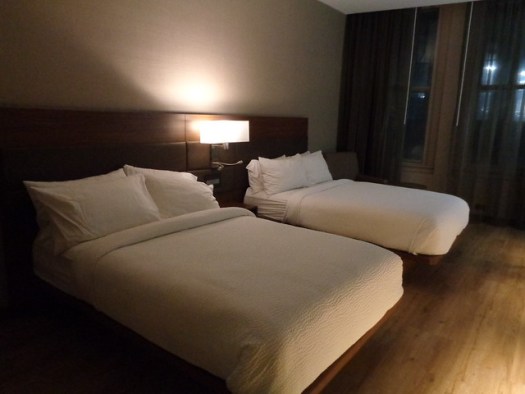
Round, Square, Rectangle (and that’s just the bathroom): AC Hotel by Marriott, New Orleans

We stayed at the AC Hotel by Marriott in New Orleans for a couple of days — it’s Marriott’s attempt at being more European so the rooms are especially uncluttered
AC Hotel by Marriott, New Orleans LA//embedr.flickr.com/assets/client-code.js

…that meaning, this low bench-like area is the only real place to put your suitcase(s), and it’s kinda going to work that way anyway, because there’s only a rod (no closet!) to hang clothes and only one small drawer in the entire room. One. Small. Drawer.

Here’s that drawer.

The soap provided is shaped like a ball. Smaller than ping-pong, really. So its usefulness-as-soap was pretty nil. At first, it’s like: “oh cool! Nobody makes soap the shape of a ball!” then: “oh this is completely why nobody makes soap the shape of a ball.”

Round soap, square toilet, flat rectangle sink that’s too flat to fully drain.

I think Marriott is trying to guise economy as European and make up the difference with upping the number of outlets/USB ports. For those of us who have been to Europe, that’s not the idea.

Love clever concepts, but they need to be so in a this-is-fun/better way, not a tried-too-hard/gimmicky way.

We didn’t hate it but didn’t love it either. Moving along.

Louisiana Old Capitol Museum, Baton Rouge — And Its Glass

Louisiana’s Old State Capitol Museum was a very short walk from the downtown Baton Rouge Hilton

Old Capitol Museum, Baton Rouge LA//embedr.flickr.com/assets/client-code.js

It was built when the capital was decided to be moved here from New Orleans, from 1847-49. The design, neo-Gothic castle, was both loved and hated. James H. Dakin, the architect, called it “castellated Gothic”.

From the Historic Register paperwork:
Like a cathedral, the Capitol has a cruciform plan. The east-west axis
is comparable to a nave and contains the House chamber on the west end
at the second floor and the Senate chamber in the apse, each with a giant
stained glass window behind the now vanished rostrum. The transepts
continue in use as office space. Each arm of the plan terminates in two
towers; those at the west are octagonal, the others square.

It suffered many destructive phases, including being used as a prison during the war. In the 1880s, the interior was redone, which is when the gorgeous interior rotunda was designed by architect William A. Freret.

It was used until the state government moved to the new capitol building in 1932.

One of the more unexpected aspects is the approximately 12-minute kitschy 4D film that explains its history.

There’s of course plenty about Huey P. Long,

One more intimate room plays ‘In Memoriam’, an original by Castro Carazo, composed for and played at Huey Long’s funeral. The room includes the pistol supposedly used to shoot Long, and this bullet mystery:
Old Capitol Museum, Baton Rouge LA//embedr.flickr.com/assets/client-code.js

It’s no wonder that the space is often rented out for weddings and other big celebrations

Old Capitol Museum, Baton Rouge LA//embedr.flickr.com/assets/client-code.js

What serve now as ballrooms were the spaces for the House and Senate
Old Capitol Museum, Baton Rouge LA//embedr.flickr.com/assets/client-code.js

New Orleans Gingerbread

Av was working in the Quarter last week, and I asked him to take some pics of some of the gingerbread displays — so great this year!

At The Roosevelt
Christmas Decorations at Roosevelt Hotel, New Orleans//embedr.flickr.com/assets/client-code.js

Gingerbread tree
Christmas Decorations at Roosevelt Hotel, New Orleans//embedr.flickr.com/assets/client-code.js

oysters, and bonfire on the levee for Papa Noel
Christmas Decorations at Roosevelt Hotel, New Orleans//embedr.flickr.com/assets/client-code.js

football and gumbo
Christmas Decorations at Roosevelt Hotel, New Orleans//embedr.flickr.com/assets/client-code.js

streetcar and beignets
Christmas Decorations at Roosevelt Hotel, New Orleans//embedr.flickr.com/assets/client-code.js

—
At the Ritz-Carlton
Gingerbread at Ritz-Carlton, New Orleans//embedr.flickr.com/assets/client-code.js

Their gingerbread house is a replica of the ‘wedding cake house’ on St. Charles Avenue. For over two months, the bakers have made/used: 390 pounds of gingerbread dough, 134 pounds of fondant, 44 pounds of gum paste, 209 pounds of royal icing, 30 pounds of chocolate, and 10 pounds of piping gel
Gingerbread at Ritz-Carlton, New Orleans//embedr.flickr.com/assets/client-code.js

Gingerbread at Ritz-Carlton, New Orleans//embedr.flickr.com/assets/client-code.js

Gingerbread at Ritz-Carlton, New Orleans//embedr.flickr.com/assets/client-code.js

Gingerbread at Ritz-Carlton, New Orleans//embedr.flickr.com/assets/client-code.js

Gingerbread at Ritz-Carlton, New Orleans//embedr.flickr.com/assets/client-code.js

Gingerbread at Ritz-Carlton, New Orleans//embedr.flickr.com/assets/client-code.js

Gingerbread at Ritz-Carlton, New Orleans//embedr.flickr.com/assets/client-code.js

Gingerbread at Ritz-Carlton, New Orleans//embedr.flickr.com/assets/client-code.js

Gingerbread at Ritz-Carlton, New Orleans//embedr.flickr.com/assets/client-code.js

Gingerbread at Ritz-Carlton, New Orleans//embedr.flickr.com/assets/client-code.js

Gingerbread at Ritz-Carlton, New Orleans//embedr.flickr.com/assets/client-code.js

—
At the Sheraton, Jackson Square in gingerbread
Jackson Square in Gingerbread at Sheraton, New Orleans//embedr.flickr.com/assets/client-code.js

Jackson Square in Gingerbread at Sheraton, New Orleans//embedr.flickr.com/assets/client-code.js

—
Harrah’s recreated St. Louis Cathedral in gingerbread
St. Louis Cathedral in Gingerbread at Harrah's, New Orleans//embedr.flickr.com/assets/client-code.js

St. Louis Cathedral in Gingerbread at Harrah's, New Orleans//embedr.flickr.com/assets/client-code.js

St. Louis Cathedral in Gingerbread at Harrah's, New Orleans//embedr.flickr.com/assets/client-code.js

St. Louis Cathedral in Gingerbread at Harrah's, New Orleans//embedr.flickr.com/assets/client-code.js

St. Louis Cathedral in Gingerbread at Harrah's, New Orleans//embedr.flickr.com/assets/client-code.js

Glass Blowing at Orbix

Three girlfriends and I drove up to Fort Payne, Alabama to visit Orbix Hot Glass gallery and do glass blowing. We took the ornament class, so my friends will be using theirs in their decorations, and I have mine in a Nambe bowl (the silver makes the glass look even better) in the dining room. I actually already have a couple of these glass orbs from Cal Breed when he used to display and sell them at Kentuck, so these are a great addition.

We had some time to shop in the gallery before we started:

Orbix Hot Glass: Glass Ornament Blowing Class//embedr.flickr.com/assets/client-code.js

Orbix Hot Glass: Glass Ornament Blowing Class//embedr.flickr.com/assets/client-code.js

Orbix Hot Glass: Glass Ornament Blowing Class//embedr.flickr.com/assets/client-code.js

Orbix Hot Glass: Glass Ornament Blowing Class//embedr.flickr.com/assets/client-code.js

Orbix Hot Glass: Glass Ornament Blowing Class//embedr.flickr.com/assets/client-code.js

Orbix Hot Glass: Glass Ornament Blowing Class//embedr.flickr.com/assets/client-code.js

Orbix Hot Glass: Glass Ornament Blowing Class//embedr.flickr.com/assets/client-code.js

Orbix Hot Glass: Glass Ornament Blowing Class

Orbix Hot Glass: Glass Ornament Blowing Class//embedr.flickr.com/assets/client-code.js

Orbix Hot Glass: Glass Ornament Blowing Class//embedr.flickr.com/assets/client-code.js

This board shows what the different glass colors will look like

Orbix Hot Glass: Glass Ornament Blowing Class//embedr.flickr.com/assets/client-code.js

Orbix Hot Glass: Glass Ornament Blowing Class//embedr.flickr.com/assets/client-code.js

While other objects have the participants actually going up to the furnaces and doing more of the process, for this class, we were doing the super-easy part. Here, Cal has taken the hot glass and is rolling it to pick up colors

Once he puts it back in the fire and has the initial form right, he sits and forms it while instructing us on how much air to force through the pipe — this is my first orb
Orbix Hot Glass: Glass Ornament Blowing Class//embedr.flickr.com/assets/client-code.js

Next he releases it from the pipe and puts on a dab more glass so as to make a circle curl so it can hang. Next, it goes into a warmer to anneal, then it can be shipped the next day.

This is one of the orbs I helped make — it is two color mixes: Maria mix, and lagoon
Glass Orbs made at Orbix Hot Glass//embedr.flickr.com/assets/client-code.js

We had an unwrapping party at my friend Jill’s new home
Glass Orbs made at Orbix Hot Glass//embedr.flickr.com/assets/client-code.js

We were all so very happy with how they turned out
Glass Orbs made at Orbix Hot Glass//embedr.flickr.com/assets/client-code.js

We really enjoyed making these; I’d love to go back and do the paperweight class and have a more hands-on experience, too! Love.

https://player.vimeo.com/video/29691230

Clementine Hunter, African House, And Errant Cat Hairs

Clementine Hunter works make up two large exhibits in Baton Rouge: one at the Louisiana State Museum, and the other at the LSU Museum of Art

At the LSU Museum, they have Clementine Hunter: Life on Melrose Plantation

When Clementine Hunter (1887-1988) was a young girl, her family moved to Melrose Plantation in search of work. Hunter worked as a field hand picking cotton and pecans until moving to the “Big House” to serve as a washerwoman and cook. Hunter’s move to the Big House was perhaps the most significant event in the artist’s life.

In the early 20th century, Melrose Plantation, owned by Cammie Henry, became a haven for artists and writers. Affectionately known as Miss Cammie, Henry opened her home as a center for creativity. She encouraged artists to visit Melrose for extended periods so that they could be productive. One of the visitors, New Orleans artist Alberta Kinsey, is credited with inspiring and influencing Clementine Hunter.

Kinsey, a frequent guest at Melrose, gave Hunter some empty tubes of paint to throw away, but Hunter kept the paints and began “marking up some pictures” in her cabin late at night. Though Hunter could not afford fresh oil paints and canvas, she continued painting on any blank surface she could find — cardboard, window shades, and bottles.

Clementine Hunter began her career as an artist when she was well into her fifties. Late at night, after her work in the “Big House” was finished and her family slept, Hunter painted her memories. She painted her life at Melrose Plantation. In her nearly forty years as an active artist, Hunter painted over 5000 images of cotton and pecan harvesting, weddings, funerals, baptisms, juke joints, and still lifes.

‘Gathering Gourds’ — the building depicted here is the ‘African House’ which was built by slaves in the 1820s. In 1955, Francois Mignon, a writer and resident of Melrose, encouraged Clementine Hunter to paint murals on the second floor of the African House. Earlier this year after a restoration, the murals were reinstalled.
Clementine Hunter Exhibit at LSU Museum of Art, Baton Rouge LA//embedr.flickr.com/assets/client-code.js

‘Picking Cotton’
Clementine Hunter Exhibit at LSU Museum of Art, Baton Rouge LA//embedr.flickr.com/assets/client-code.js

‘Wedding’
Clementine Hunter Exhibit at LSU Museum of Art, Baton Rouge LA//embedr.flickr.com/assets/client-code.js

The State Museum includes dozens of her works
Louisiana State Museum, Baton Rouge LA//embedr.flickr.com/assets/client-code.js

Louisiana State Museum, Baton Rouge LA//embedr.flickr.com/assets/client-code.js

‘The Annunciation, Pregnant Mary with Doctor Arriving’
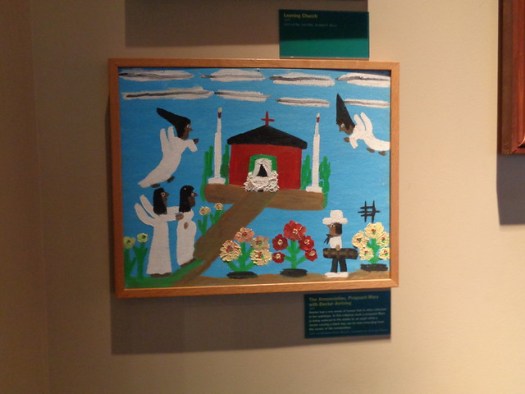
Clementine Hunter Exhibit at Louisiana State Museum, Baton Rouge LA//embedr.flickr.com/assets/client-code.js

‘Black Angels’
Clementine Hunter Exhibit at Louisiana State Museum, Baton Rouge LA//embedr.flickr.com/assets/client-code.js

‘The Wash Day’
Clementine Hunter Exhibit at Louisiana State Museum, Baton Rouge LA//embedr.flickr.com/assets/client-code.js

including some paintings on glass

—
This summer, Melrose Plantation raised enough money to have two more of Clementine Hunter’s works sent to Houston at Whitten and Proctor for conservation.

—
Robert Wilson, a theater artist who met Clementine Hunter as a child, did the ribbon cutting at African House when it reopened to show the restored paintings — his Watermill Center on Long Island recreated African House as a tribute; more pics here.

—
An article in Science earlier this year, How Cat Hair Brought Down a Pair of Art Forgers, discussed the Toyes, a couple in New Orleans, who regularly made forgeries of Clementine Hunter paintings.

In 2009, the Federal Bureau of Investigation finally gathered enough evidence to confiscate the Toyes’ supposed Hunter collection, and during the raid they noticed that “they lived in a very modest house with approximately 30 cats,” Magness-Gardine says. When forensic investigators analyzed the seized works, they found cat hair embedded in the paint—a characteristic not shared by Hunter’s authentic work. “That’s essentially what brought them down,” Magness-Gardine says. William Toye pled guilty to art fraud in 2011.

—
This very good piece, Looking for Clementine Hunter’s Louisiana in the NYT by Jennifer Moses, mentions Gilley’s Gallery in Baton Rouge, *the* source for authenticating a Clementine Hunter work.

https://static01.nyt.com/video/players/offsite/index.html?videoId=100000002281585