Twenty-plus years of documenting the South's vernacular art, visionary environments and traditions….plus modern art exhibits, Faulkner and Eudora, and This Week's Various. Welcome.
The last time we visited Holly Beach in Louisiana was 2006, and you can see from the right-hand side of this pic that almost nothing was left after Hurricane Rita:
We wanted to come back to play this summer, and it looks so much better now:
It’s the Cajun Riviera (one home boasts it on a street-facing wall, too). You just drive onto the beach, park right on the sand, and make yourself at home. Terrific shells all around. Happy seagulls. Happy families.
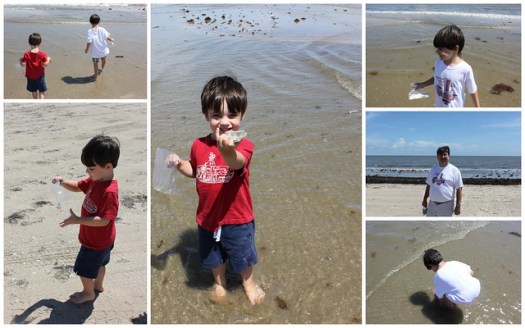
The boys love beaches so of course they were happy, happy, happy:
Afterwards, we kept going on the Creole Nature Trail. I like how this road curves right in front of the water so it looks just like this ship floating by is crossing the street:
…and then we rode across the Calcasieu Ship Channel on the ferry, which the boys also liked:
— Every trip to the beach we make with the boys, we bring back a wee little bit of sand and shells and put it in this large jar on the dining room sideboard — there are probably a dozen or more different beaches here from Florida, Alabama, Mississippi, and Louisiana and double that in visits since the boys were born. Love thinking about all these trips.
As is tradition in parts of Alabama and elsewhere, cemeteries (and terribly rare now, some homes’ yards, still) are kept ‘swept’ — free of grass. Since this custom appears less and less, it was great to find this one in Northport at Macedonia UMC; there are now ten cemeteries in Tuscaloosa county on the Alabama Historic Cemetery Register and getting this one on should probably be pretty easy.
There are many, many monuments made of local stone:
…and several ‘tent’ monuments:
— Going against what people usually consider appropriate at cemeteries, there could hardly be a more wonderful place to watch Sunset Boulevard (one of my favorite movies) than at Hollywood Forever, the cemetery in LA that is *always* doing wonderful things. They’re showing the film August 4 on the lawn — and not only do they show films, but they do concerts and other activities. The Hollywood Forever DDLM has to be pretty terrific, too.
As always, unless otherwise noted, all images here copyright Deep Fried Kudzu. Ask me before using in any fashion. Thank you.
— *Crushed* that Hubig’s burned down this morning. The owners are already vowing to be back. Glad I had one last week, and can’t wait to have another one, once they get rebuilt (hopefully still in the city).
Sweet Mozell Benson, from the Alabama Craft: Tradition doc (she passed away last week):
— Sharon McConnell Dickerson has done an amazing thing: lifecasts of Mississippi Delta Blues artists. She’s lost her vision, but that hasn’t slowed her down. She says, “In Mississippi, I can ride through the Delta’s endless cotton fields and empty landscapes and can almost breathe in the cotton fibers, smell the earth, and feel the heaviness of its moist air on my skin. I can empty my mind and feel freedom. It is within this simple landscape that I am finally home.” Videos of her work here (including her lifecasting of Ruth Brown – love, love, love).
—
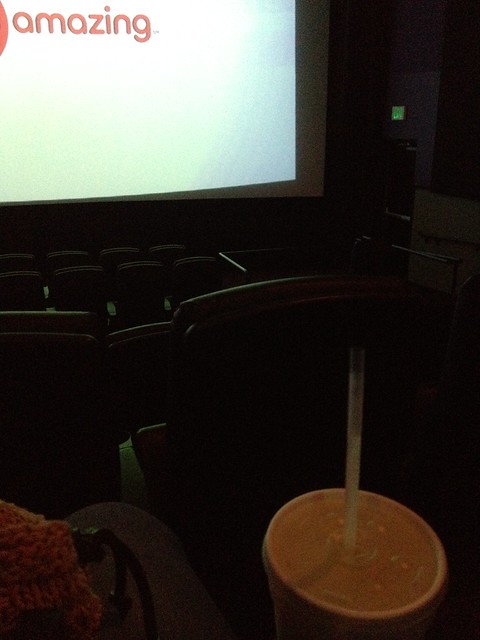
I saw ‘Beasts of the Southern Wild‘ almost three weeks ago in New Orleans — it opened there earlier than most of the country — and it’s good. It’s different, and it’s almost impossible to describe, other than to say that it captures the kinds of over-the-top fantastical visions that children have and sets those aside this sort of terribly gritty realism that is to varying degrees everyday life. In any case, the gentleman who plays Hushpuppy’s father in the movie is actually Mr. Henry from the Buttermilk Drop Bakery (with…buttermilk drops, a la McKenzie’s) in the 7th Ward. Oh, and I go to the AMC Elmwood Palace 20 in Harahan because there I can get a frozen margarita in a classy styro cup! I grew up in a dry county; it’s still a big deal.
One of the people responsible for HealthConnect’s holistic, intensely personal approach is Dr. Aaron Shirley, who three years ago found inspiration for health care reform in an unlikely place: the primary health care system created in the 1980s in the Islamic Republic of Iran. The main issue in Iran back then was “disparities in health between its urban and rural populations,” he told me recently. “In the U.S., these disparities exist. The Iranian model eliminated the geographic disparities, so why couldn’t this same approach be used for racial and geographic disparities in the U.S.?” ….. Later that year, several Iranian doctors and administrators and their wives made their own trip to Mississippi. They were surprised by what they saw: “This is America?” they asked. In 2010, the Iranians returned for a month, calculating how many health houses Mississippi would need, as they had done in Iran. ….. Human Rights Watch calls the Deep South “the epicenter of the H.I.V. epidemic in the United States, with more people living and dying of AIDS than in any region in the country.” Blacks in Mississippi are dying from AIDS at a rate 64 percent higher than the nation’s average. In the delta, which stretches north and west of Jackson and is home to 560,000 people, H.I.V./AIDS is an immense but silent crisis. The state Department of Health estimates that half of H.I.V.-positive Mississippians currently don’t receive treatment.
— The UK’s Guardian is asking for input on the Greatest American Novelist (the author has to have written at least four books, so there goes Nelle Harper Lee), and they’re down to 32.
— Magnolia, Mississippi homes:
They have three 1939 WPA/New Deal oil-on-canvas murals by John Fyfe at the post office: “Magnolia in 1880,” “Cotton Harvest,” and “July Fourth Celebration at Sheriff Bacot’s”
— The Philadelphia CityPaper doesn’t like everything that Regis Jansen from South Alabama does, but they write that ‘An Alabama boy gives Rex 1516 a (fairly) proper drawl.‘:
Perhaps that’s what inspired Jill Weber, of across-the-street wine bar Jet, and partner Evan Malone to turn 1516 into a restaurant with a “faded mansion” aesthetic. When she hired Alabama native Regis Jansen as the chef, that look earned an extra adjective: Southern faded mansion. What does this look like, you ask? Think distressed-wood floors and exposed brick, marble and mahogany. Think frosted-glass pendants large as ripe cantaloupes, dripping smoky light. Think a Louis XIV sofa that begs for Vampire Jessica or an equally lithe young creature to drape across it. Faded Southern mansion? As a Penn anthropologist, Weber should know.
The dreamlike ambience of this four-month-old restaurant is convincing, but it’s Jansen’s bayou breeding that imparts a truer sense of the South. The lanky 29-year-old is a life-sized licorice whip; it’s hard to imagine him growing up in Fairhope, outside Mobile, on a steady diet of his mom’s home cooking. When Jansen adapted her crawfish pot pie recipe for Rex 1516, “I had to cut the amount of cheese by three-quarters!” ….. The best way to end a meal at Rex, though, is the king’s gateau, a column of flourless chocolate cake cloaked in waves of airy peanut-butter mousse and garnished with peanut brittle and banana ice cream. The king to which this confection refers is, of course, Elvis Presley, he of the proclivity for peanut-butter-and-banana sandwiches. But it’s hard to imagine any monarch, past or present, turning this dessert away.
I just looked at their menu, and one of the supper appetizers is fig bruschetta: goat cheese, rosemary, red wine poached figs, caramelized onion. Yummm… And for dessert, I’ll have Sticky Toffee Bread pudding: Honey Brioche, Southern comfort coffee, dates, vanilla bean custard, fried mint, orange-maple whipped cream. Yes, please. How about these cocktails…
— How to Rebuild the Mississippi Delta (and by here, they mean the river delta) at the NYT: …Bonnet Carré redirected 10 to 20 percent of the Mississippi’s floodwater out of the river and into Lake Pontchartrain.
While the diversion mitigated the havoc created by the flood, it also provided a few scientists with an opportunity to do some research on land restoration in the Mississippi Delta as the Bonnet Carré’s floodwater dried out in subsequent months and left behind huge dunes of sand. Their findings, published this week in a Nature Geoscience letter, indicate that well-placed floodwater diversions can add significant amounts of land to the disappearing delta.
Our study “demonstrates that there’s a strong feasibility or potential to build new landscape in Louisiana,” said Jeffrey A. Nittrouer, a geologist at the University of Illinois and the lead author of the letter. He said the recent use of the Bonnet Carré spillway showed that by choosing the right place to build a diversion in the Mississippi and opening it at the right time, planners could build up a substantial amount of sediment in the delta.
— I extra-special love people on vacation (took this at the beach in Mississippi):
— The PNJ writes, with recipe, about Chef Blake Rushing’s terrine of Gulf shrimp and cole slaw, pickled aspic, wasabi tobiko, spicy mustard and hot pickled banana peppers from Pensacola’s Lee House B and B.
— The Rural Studio has celebrated the building of 20K house v11 (Turner’s house).
— Shug at the lake at Av’s high school:
— As part of BP’s ‘Spirit of the Gulf’ series for Olympic athletes (gosh, BP.) and guests, Gulf Coast chefs are going to London to serve seafood dishes, including 160 lbs of gumbo. The group includes chefs John Folse and Michael Sichel from Louisiana, Chris Sherrill and Alec Naman from Alabama, Chris Poplin and Calvin Coleman from Mississippi, and Paul Stellato of Florida.
— HBO has released this in anticipation of Treme’s third season, debuting on September 23:
— Jerry Mitchell in the C-L interviewed John Evans, owner of Lemuria Books in Jackson, who ‘compared reading a book to eating a meal, saying the difference between spending time with a real book versus an e-book is the same as savoring a hamburger versus swallowing a vitamin.’ Agree. And Lemuria is a fine, fine book store.
— If you ever wonder how to send a cease-and-desist and make it more nice than nastygram, see how much good will Jack Daniels has garnered in their response to the book, ‘Broken Piano for President’.
— The Mississippi Museum of Art has received a grant from a American Association of Museum partnership and has “been selected to participate in Round 2 of the Innovation Lab for Museums – a unique incubation and prototyping program to foster programmatic and organizational innovation in the museum field.”
— An 80-year-old, 40ft x 60ft painting that had served as a fire curtain was rediscovered at Montgomery’s Town Hall this month after years of being forgotten.
— Charles Hagood of Moulton, who was a good neighbor and very well-known for his chicken stew (which is a food especially well-liked and traditional in northeast Alabama), passed away this month.
Chicken Stew:
— Beautiful: the Bastille Day fireworks we saw in New Orleans a couple of weeks ago:
From a low-slung, beige block building with a somewhat confusing history (like: they are ‘Old Greenbrier’ and are in the older building but the original Greenbrier is in the newer building (people are still ticked about them moving up to the highway)) Greenbrier Restaurant serves up some of the best barbecue chicken and catfish you can get anywhere.
You can’t just say you’re going to Greenbrier; you have to say which one, and you have to make sure the person you’re talking to ‘gets’ the difference the same way you do. In any case, there’s been barbecue coming out of this building for ages. And, big surprise, Greenbrier Restaurant gets asked about selling those great Double Cola ‘Hushpuppy’ and ‘Pork’ signs all the time:
I’m lucky because when I visit my artist friends in Huntsville (incl. Wade and Conor), we just go here. This is our default lunch place. Yay!
Mexican restaurants put out chips and salsa. In good north Alabama barbecue restaurants, they rush to your table with steaming-hot hushpuppies and white chicken sauce.
North Alabama still life, with half those Zeppelin-shaped hushpuppies already doused in sauce:
White chicken sauce is a north Alabama construct, begun in Decatur decades ago with Big Bob Gibson and migrating eleven miles east here to Greenbrier. Then the white barbecue sauce phenomenon flows further along, all over Huntsville, and all along some imaginary line, south to Cullman and north to the Tennessee border. But that line has all kinds of holes in it, because Miss Myra (who grew up in Decatur) is serving it in Birmingham and the Cypress Inn in Tuscaloosa has it too. It’s in Pensacola and Nashville. The secret — if it ever was a secret — is out. The chicken they serve at Greenbrier Restaurant is crazy-good. It doesn’t need any help. But, well, when you have white barbecue sauce on the table, you just…
Oh, and if you’re a regular here you know that tucked around the corner where you’d never expect it is an ice cream machine that runs on an honor system at $.25/cup.
— Those dreamy hushpuppies they serve are so good that the man who owns the restaurant sells copies of the…machine…he uses to make them at $1295. It’s called a ‘Hushpuppy King‘ and is described as a ‘hushpuppy Gatling gun’; no wonder.
Av was at Tuskegee University last month for a conference, and they met in the Paul Rudolph-designed chapel. I’ve been on the campus many times but never inside the chapel, so I was really excited to see:
The original intent was to build the chapel out of concrete.
I wish he had taken a thousand other pics, because the building (built 1967-69) has a lot of architectural interest — one being the lack of exact right angles. Besides Paul Rudolph, a firm led by John A. Welch and Louis Fry, who were former Tuskegee faculty members, worked on the plans.
Paul Rudolph, besides work on the chapel, had been commissioned in the late ’50s to produce a master plan for the campus, which was not implemented. He did a master plan revision in 1978.
Also inside are reproductions of the stained glass ‘Singing Windows’ that had in 1932 been installed in the original chapel (built 1896-98, burned 1957).
From the Tuskegee website: “It has been described as “one of the remarkable structures designed for any college in the United States and abroad.”
The Chapel has long served as the center of campus for religious, cultural and intellectual gatherings. Guest speakers for both the original as well as the present chapel have ranged from U.S. Presidents, foreign heads of the state, and other persons of note, such as Mary McLeod Bethune and Martin Luther King , Jr. Currently, the Chapel serves as the home of the famed Tuskegee University “Golden Voices” Concert Choir.”
Also: the chapel isn’t the only Paul Rudolph -designed building on campus. The Kresge Center and the Chappy James Aerospace Science and Health Education (below) buildings are his, too.
— Paul Rudolph lived for a time in north Alabama; he graduated from Athens High School there then graduated college from Auburn. I’ll post pics of another of his designs soon.
After WWII, where he worked at the Brooklyn Navy Yard, he attended Harvard where he studied with Walter Gropius (think: Bauhaus) and had I.M. Pei and Philip Johnson as classmates. Later on, he practiced in Florida, then eventually became chair of the Department of Architecture at Yale.
— Postscript (7/31): I got a hilarious email today about how I mistakenly spelled I.M. Pei as I.M. Pie in my first version of this post, even though I know better!! Southern girl, indeed. Sometimes I feel like I.M. Pie!
I have been meaning to post these pics forever — this is from our March trip to Donald Link’s (who we already were fans of thanks to Herbsaint) Cochon Butcher on Tchoupitoulas.
Well, we got there during the busiest part of the lunch rush, and they were out of space, so we decided to just take it to-go as a picnic.
Duck slider:
The macaroni and cheese, which Shug liked, especially:
Pork belly, with mint and cucumber:
Head cheese:
Donald Link was a nominee this year for the James Beard ‘Outstanding Chef’ and won Best Chef in the South in 2007. His Real Cajun cookbook (which I have and is really great) won a James Beard award few years ago, too.






You must be logged in to post a comment.