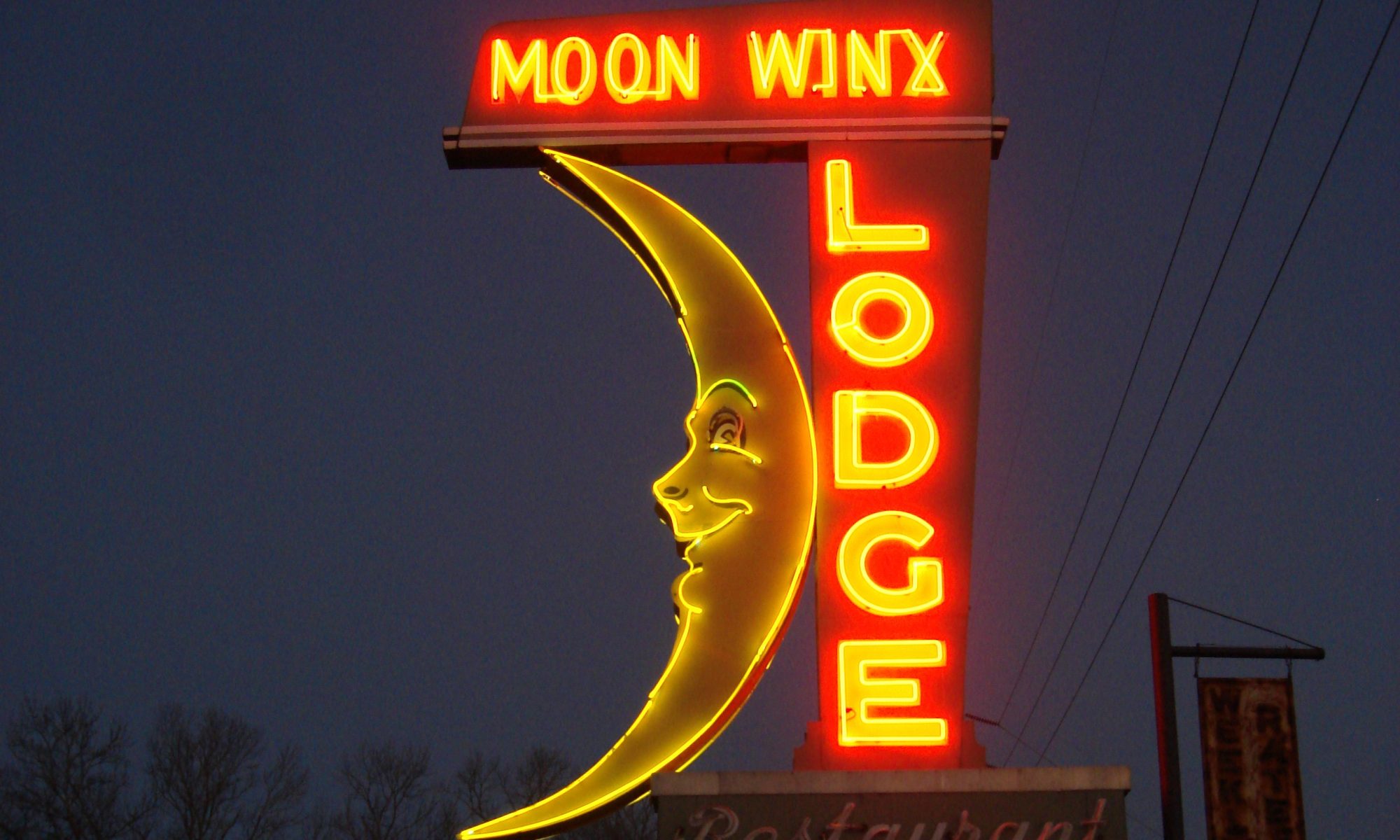
I found this outside a carpet store in Sylvania, Alabama:
This Week’s Various
Sylvia Woods, who opened the famous restaurant ‘Sylvia’s‘ in Harlem passed away this week. From the NYT:
Sylvia’s Restaurant opened on Aug. 1, 1962 — with six booths and 15 stools — at Lenox Avenue near 127th Street, offering soul-food staples like ribs, hot cakes, corn bread and fried chicken. The immense popularity of its dishes earned Ms. Woods the sobriquet the Queen of Soul Food.
… …
The daughter of a farming couple, Van and Julia Pressley, Sylvia Pressley was born in Hemingway (SC) on Feb. 2, 1926; her father died when she was a baby.
… …
Sylvia met her future husband, Herbert Deward Woods, when she was 11 and he was 12 and both were working in the fields, picking beans under the blazing sun.
As a teenager, Sylvia moved to New York to join her mother, who had gone there for work. She found work herself, in a hat factory in Queens. In 1944, she married Mr. Woods, who had come North to claim her.
In the 1950s, Ms. Woods began work as a waitress at Johnson’s Luncheonette in Harlem; because she had grown up poor in the Jim Crow era, the day she first set foot in the place was the first time she had been inside a restaurant anywhere.
In 1962, with help from her mother, who mortgaged the family farm, Ms. Woods bought the luncheonette and renamed it Sylvia’s. Three decades ago, Gael Greene, the food critic of New York magazine, wrote a laudatory article on Sylvia’s, sealing the restaurant’s success.
Also, it looks as though Sylvia’s may open a restaurant in south Florida next year.
—
The Slugburger Festival in Corinth is as of this year a part of the Major League Eating circuit (they said the MLE reached out to them); the winner this summer downed 30 slugburgers in ten minutes.
—
Sweet Mozell Benson, a National Heritage Fellow for her quilting, passed away this week.
—
Bravo has a new show starting August 13, called ‘Gallery Girls‘: Bravo’s Gallery Girls is a docu-series that follows the lives of seven dynamic and ambitious young women in New York City who tackle the cutthroat environment of the art world while vying for their dream jobs. From gallery openings and art shows to the hottest events in the city, the women share a passion for art…
—
If you saw the ‘Booker’s Place’ piece on Dateline NBC last week…the people at Lusco’s (where Booker worked) have a whole different view of their relationship with Booker and the community (you may need to click on ‘see more recent stories’ to view it on FB).
—
Nice article on cordwood architecture/building in the NYT.
—

The ‘first comprehensive biography of this regional self-taught painter, who attracted the attention of the world’ will be published as “Clementine Hunter: Her Life and Art,” from LSU Press, and will be available this September.
—
Uncle Lionel Batiste was embalmed so as to stand during his wake (so wonderful!! pic in the Times-Pic) and here’s more from his funeral.
—
Gourmet.com on ‘10 cities where the music’s hot and the food rocks‘ — including Athens, GA; B’ham; Lafayette; Nashville.
—
Marc Smirnoff and Carol Ann are out at the Oxford American.
—
Greenville has been declared (by its mayor) the official ‘Hot Tamale Capital of the World‘ but I lean toward Clarksdale (blowing a kiss that direction to Hick’s).
—
‘Behind the Low-Priced Clothing, a Priceless Midcentury Sculpture‘ at NYT about the Harry Bertoia piece on display now at the new ‘Joe Fresh’ shop on W 43rd. AND there’s this great piece about Barton Lidice Bene’s home/belongings being packed up and sent to the North Dakota Museum of Art to be reconstructed for exhibit.
—
…and in Irondale, AL #signfail:
Barbecue Spaghetti, Too
The last time we were in Memphis, we had lunch at Jim Neely’s Interstate Bar-B-Q. We’ve had some fantastic barbecue in Memphis — Central, Payne’s, Corky’s, and some others (next time we want to try Top’s, Cozy Corner, and Bar-B-Q Shop).
If you’ve seen the Neelys on Food Network, Pat is Jim’s nephew. The way I understand it, Pat worked for Jim, and then later on when Pat wanted to start his own restaurant, Jim helped him with the pit. So this is Jim’s restaurant, the older Neely barbecue restaurant.
Av got the sampler platter which is enough food for the four of us, and gives a taste of everything. Pretty good. 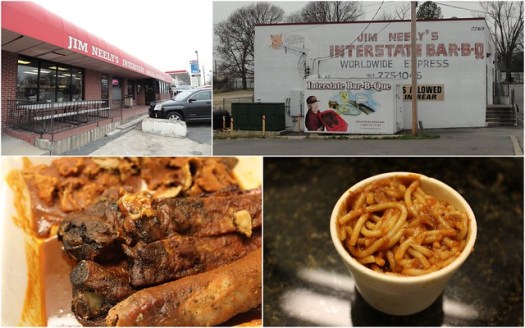
The bottom-right pic above is their barbecue spaghetti — which has made its way to Charlotte, even. One recipe here.
—
Top Hat in Blount Springs, Alabama is some of the barbecue I grew up with, and I love to hear Dale Pettit talk about it — they’re making real barbecue, not with gas or a big rotisserie setup. Still splitting hickory every day:
Miss Eudora

Miss Eudora Welty lived most of her life here at what was her parents’ home, 1119 Pinehurst. Today, it’s a museum at which you can view her writing desk, the books on the dining room table, the upright Steinway. It’s a National Historic Landmark today. While I’ve read many, many of her works and know little things like she did her shopping at Jitney Jungle No. 14 (it’s a McDade’s now), she preferred Maker’s Mark, and she liked the redfish at Bill’s, for whatever reason I just have never made the reservation to come see her home. I will soon.
…and Bill, he’s a character:
Here’s Miss Eudora talking about ‘A Worn Path’:
…and it always makes me smile to recall that when she worked for the WPA and collected recipes, she wrote in her manuscript for ‘America Eats’ among the stuffed eggs and Hotel Vicksburg potato salad that “Yankees are welcome to make these dishes. Follow the directions and success is assured.”
She’s buried near her home, at Greenwood Cemetery, which is interesting on its own. I took these pictures in March, when the wisteria was in full, glorious bloom:
She’s buried here, next to her brother who passed away as a baby before she was born. In ‘One Writer’s Beginnings’, she recalls a moment as a child with her mother after she found a little box with two polished buffalo nickels in a bottom bureau drawer.
“No!” She exclaimed in a most passionate way. She seized the box into her own hands. I begged her; somehow I had started to cry. Then she sat down, drew me to her, and told me that I had a little brother who had come before I did, and who had died as a baby before I was born. And these two nickles that I had wanted to claim as my find were his. They had lain on his eyelids, for a purpose untold and unimaginable. “He was a fine little baby, my first baby, and he shouldn’t have died. But he did.”
The quote on the front of her monument is from ‘The Optimist’s Daughter’: For her life, any life, she had to believe, was nothing but the continuity of its love.

And here:
The memory is a living thing — it too is in transit. But during its moment, all that is remembered joins, and lives — the old and the young, the past and the present, the living and the dead.
As you have seen, I am a writer who came of a sheltered life. A sheltered life can be a daring life as well, for all serious daring starts from within.
Crystal Shrine Grotto
Most faux bois artists probably don’t imagine that some of their most elaborate works will be found in cemeteries, but with their serene park-like settings, maybe cemeteries are among the better choices — and that’s exactly where Dionicio Rodriguez did much of his work earlier in the 1900s.
This past winter, we went to Memorial Park in Memphis to see what he had created when the cemetery hired him in 1935 to beautify the landscape:

Wow, did he ever:
The building above with the two windows and the doorway, is what the artist designated as the ‘Cave of Machpelah’ which is the cave of the Patriarchs from the Bible — the land and cave that Abraham had purchased, in Genesis. Buried there were all the Patriarchs and Matriarchs — Abraham, Isaac, and Jacob; Sarah, Rebecca, and Leah (leaving out Rachel because she had been buried at Bethlehem).
Av has been to the Cave of Machpelah in Hebron…it’s a mosque now. I’ll post pics from his visit next week, along with his pics of the Tomb of Rachel.

Abraham’s Oak:
It’s made entirely of concrete reinforced with steel and copper bar.
The work here was completed in 1938. This is the famous Crystal Shrine Grotto:

Inside, rock crystal (quartz):
Inside are depictions of the life of Jesus — some are sculpted in plaster by Marie Craig (late 1930s), and some in wood by David Day (1970s):
I have pics from two other cemeteries that have Dionicio Rodriguez sculptures — I’ll put those up in the next week or two.
The Ties That Bind
Kohler Arts Center in Wisconsin is putting on an exhibit, ‘The Ties that Bind,’ beginning July 22 of Dr. Charles Smith’s works from a home he had in Illinois. He apparently had gone to Kohler asking for their assistance in caring for the sculptures at that site. A couple of years ago when I was in Hammond, Louisiana, I went by Dr. Charles Smith’s home here:


Kohler’s statement regarding the works from the Illinois site that make up the exhibit:
The figures that populated Smith’s yard are heroes and heroines, spiritual leaders, artists and musicians, athletes, and personal friends. His subjects convey pride, celebrate talent, acknowledge despair, reflect endurance, and embody the ability to survive through resilience, humor, and joy. Smith sculpted an educational environment where Martin Luther King Jr. and Malcolm X testify while a black “drunk driver” elsewhere sits disgraced. In Smith’s world, images of loving grandmothers were juxtaposed with those of violent gang members, slaves with bleeding welts, African tribal figures, and laughing children. Cultural ancestry is blended with details of American history.
The artist used the detritus of his own neighborhood, melded with a concrete mixture, to make many hundreds of figures. Smith recognized that the act of making sculptures not only helped him face his personal demons but also allowed him to tell stories he believed must be told…
You must be logged in to post a comment.