Twenty-plus years of documenting the South's vernacular art, visionary environments and traditions….plus modern art exhibits, Faulkner and Eudora, and This Week's Various. Welcome.
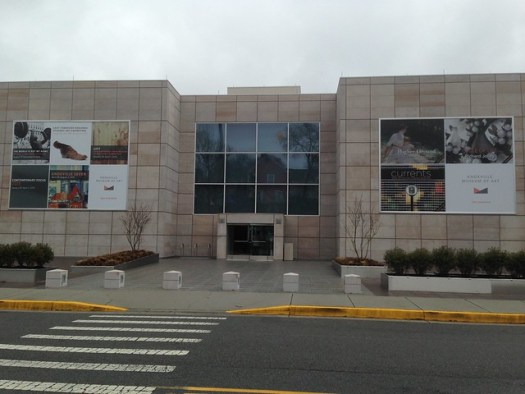
The Knoxville Museum of Art — rightly (and intelligently) — has an emphasis on not just one or two galleries of regional art, but rather it seems the vast majority of the building is devoted to its place.
Between the regional student art exhibit, the Higher Ground exhibit of East Tennessee Art, the Currents exhibit of more contemporary art with some southern pieces, and the Richard Jolley installation (he grew up in nearby Oak Ridge), KMA is filling this niche beautifully.
A close-up, to show detail. Made of sequins with pins, rubber stoppers, foam core to allow for depth: A bit more staid than her more recent mosaic from 2012.
One of our top two or three places to have lunch is Root on Julia Street in New Orleans.
I love sharing — and so for my lunch, I knew I would want everything on this platter (all of the pickled okra, strawberries, the relish, etc) minus the charcuterie Av picked: the juniper cured duck prosciutto and one other — but I did add one protein, the truffle-scented chicken liver parfait there in the little jar, which I decided was the *single best thing eaten all year*. Yes. Yes.
Av had the Cohiba smoked scallops (all done inside this cigar box) with chorizo dust, caramelized cauliflower, pimenton patatas bravas, black garlic fennel choucroute:
Next? Root’s sister, Square Root. 12-15 course tasting menu. Oooooh yes. This, from Phillip Lopez’s Instagram on a dish there:
Royal Barbers in Mobile, Alabama: Above, complete with the ‘Christmas Story’ leg lamp in the front window (and I took this pic this past summer). A Bear Bryant Coke bottle, too.
Since it re-opened, we have been wanting to stay at the Battle House Renaissance Hotel in Mobile — it was built in 1908 on the site of Andrew Jackson’s headquarters here during the war of 1812, and at the original Battle House hotel (that burned at this site, previously), Stephen A. Douglas was a guest the evening he lost the presidency to Abraham Lincoln. The hotel closed in the mid-70s and was bought and renovated by the RSA, and reopened in 2007. It’s just so pretty.
This skylight is original to the rebuilt 1908 Battle House:
These are trompe l’eoil — portraits of King Ferdinand V:
George Washington:
King George III:
…and Louis XIV:
Our room:
Not Front Desk, but the button for ‘Delighted to Serve’:
…and we had a great view of Mobile:
The hotel is right downtown, so it is perfect for walking to anything — anything on Dauphin Street, the Outlaw Convention Center, Bienville Square, Gulf Coast Exploreum…
As always, all images here unless otherwise noted are copyright DeepFriedKudzu.
Dave Meaders, fourth generation of the famous Georgia pottery family, may be loading up his kiln for the last time if something isn’t done, from the Gainesville Times: The family member who owns the Lula property where much of the Meaders’ family legacy is located — including Meaders’ kiln, his father Reggie’s old pottery workshop, and the house where David Meaders lives — wants to sell it to pay for the care of David Meaders’ mother, who is in assisted living.
Campaigns and supporters have sprung into action to help Meaders purchase the property, not just so he can keep his livelihood and home, but to preserve an artistic legacy central to the history of Northeast Georgia.
If he isn’t able to purchase the property, Meaders said he didn’t know what he would do.
“It’s the end of the world as I know it,” Meaders said. GoFundMe Campaign here.
— Above: one of the Rural Studio homes in Hale County.
The American Institute of Architects selected Auburn’s Rural Studio to receive the 2015 Whitney M. Young Jr. Award. From the press release: The award was granted in recognition of the student-led design/build projects that Rural Studio established to address the dire needs of one of the South’s poorest and most underserved regions.
Established in 1972, the Whitney M. Young Jr. Award has honored architects and organizations that embody the profession’s proactive social mandate through a range of commitments, including affordable housing, inclusiveness, and universal access. The award is named after the civil rights–era head of the Urban League who confronted—head-on—the AIA’s absence of socially progressive advocacy at the 1968 AIA National Convention.
— above: the Edmund Pettus Bridge at dusk
The March Quilts, to celebrate Alabama’s civil rights legacy: …volunteers are invited to participate in open sewing sessions and create 7-inch quilt blocks, which will be used to construct large, commemorative narrative quilts. In March, the quilts will be exhibited in Selma and Montgomery during the 50th anniversary observance and then return to Birmingham for a special celebration.
— Whitney Plantation, on the River Road, is now open for tours. The main emphasis is on the slaves there, not some moonlight-and-magnolias tour of the plantation owner’s home. From the website: This year, the Whitney Plantation opens its doors to the public for the first time in its 262 year history, as the only plantation museum in Louisiana with the focus on slavery. Through museum exhibits, slave narratives, memorial artwork and restored, historic buildings, Whitney Plantation visitors will be immersed in the world of an 1830’s sugar plantation and the world of the people whose labor made it one of the most successful in Louisiana.
— Above: one of the front rooms at Graceland Too
There was never any doubt, if you knew him, how eccentric Paul MacLeod was. Going to Graceland Too was a thrill (as was receiving my Graceland Too Lifetime Membership card) — almost a feeling of having survived with this experience you can only have at this one place on earth — the manufactured stories about Bill Clinton and famous actresses visiting and making fantastical offers, the value of his collection, his guns, Paul’s Coca-Cola addiction, a song or two sung too loud in your face, the clatter of his dentures and shoulder pokes, and having to hear about Paul’s other predilections. This article came out this week about both families — Paul’s, and the family of the person who allegedly was trying to break in for money. Tragic.
The Last Days Of Graceland Too Paul Macleod’s memorabilia-stuffed Elvis shrine was the pride of Holly Springs, Mississippi, for 25 years — until this July, when MacLeod shot a man to death over $10, then died of a heart attack immediately afterward. What will become of MacLeod’s dubious treasures, and two families ruined by hero worship at its most obsessive, is a drama worthy of a king.
— How Gone With the Wind Took the Nation by Storm By Catering to its Southern Sensibilities in Smithsonian. Nothing really stunning, but this was interesting: So concerned were Georgians with Leigh’s preparation that they created an agricultural problem: when the actress said she wasn’t familiar with the june bug, hundreds mailed specimens to her at Selznick-International Studios in Culver City. The California agricultural commission, worried about the Georgia insect’s effect on western peach buds, reportedly asked the post office to stop mailings from Georgia to Vivien Leigh.
— At Hyperallergic: A Single Woman Is a Witch: Battling to Save the Art Environment of Mary Nohl The Kohler ran into opposition from Nohl’s wealthy neighbors — they objected to even the most restricted use of the house as a museum or study center. The building fell into disrepair and with each new winter has become increasingly fragile, weathered, marooned in uncertainty. Then, in March of this year, the property’s current owner, the John Michael Kohler Arts Center, issued a press release stating that it had given up preservation efforts and will move the house and yard sculptures to Sheboygan County, where it is located. The center will sell the land to fund the move.
Dr. Martin Luther King Jr. and Rosa Parks first heard folk singer Pete Seeger sing “We Shall Overcome” in the school’s tiny, rustic library in 1954, when the first civil rights workshops were being held for activists who spoke quietly of a movement that would shout at the world.
It was branded King’s “Communist training school” by the Georgia Commission on Education; targeted by a congressional Senate security subcommittee, IRS and FBI investigations; and padlocked by the state of Tennessee, which seized and later sold the buildings and land. —
That wasn’t the only move from the Delta — there was the great migration of Blacks to Chicago, as well. This article in the Chicago Reader mentioned it briefly, and there was this paragraph in particular on barbecue: The north side thinks of itself as being in a barbecue renaissance, but to a purist like Adams, who tends a blazing pit all day long, the often acclaimed Texas-style barbecue that’s coming out of gas-fired rotisserie cookers with attached smoke boxes isn’t really barbecue at all. “You got to do it with wood fire on the south side. There ain’t no Southern Pride on the south side,” he says, referring to a brand of smoker commonly seen in barbecue restaurants. “Once you cook with a Southern Pride, you lose your whole heritage. You lose your whole lifestyle.”
— From the WSJ: Young members of Louisiana’s Houma Nation try to reclaim tribe’s lost language The fate of the Houma language is not unique. Linguists say that the rate of language extinction is accelerating and that by the next century, nearly half of the 7,000 languages spoken around the world today — like the Houma, mainly spoken by small tribes in remote places — will probably disappear because of cultural assimilation and globalization.
— Really Various:
Trader Joe’s Customer Choice Award Winners: Favorite Products of 2014. And who didn’t know that Speculoos Cookie Butter was going to be #1?
The ‘regional burger’ at the new Smashburger in North Raleigh is the ‘Carolina Chili Burger’ with beef chili, American cheese, chopped yellow onion, coleslaw, and (what else?) Duke’s mayonnaise.
This is what won $1M in the 47th Pillsbury Bake-Off. It’s…pie crust candy.
A small college in Kentucky is offering scholarships for students to play certain video games well. Here in Kudzuville, we are open to top-level college recruiters for Shugie, who is a master at Mario Kart — makes Rainbow Road look like a sunny Sunday drive on the Trace — and wants to be an internist when he grows up.
Over the new year, we were in Knoxville and visited the Knoxville Museum of Art. Because this weekend is the closing of the Regional Student Art Exhibit, I’m posting a few of those works now.
This work received ‘Best Sculpture’ — ‘The Envelope Dress’, by R. Nief:
‘What Dreams May Come’ by E. Ayala:
‘Best Painting’ — ‘Sweet Joseph’ by A. Orlandini:
‘Chaos on High’ by H. Allen:
‘Best Mixed Media’ — ‘House at the End of the Street’ by S. McNelly:
— Images from the permanent collection will be posted next week.



You must be logged in to post a comment.