Twenty-plus years of documenting the South's vernacular art, visionary environments and traditions….plus modern art exhibits, Faulkner and Eudora, and This Week's Various. Welcome.
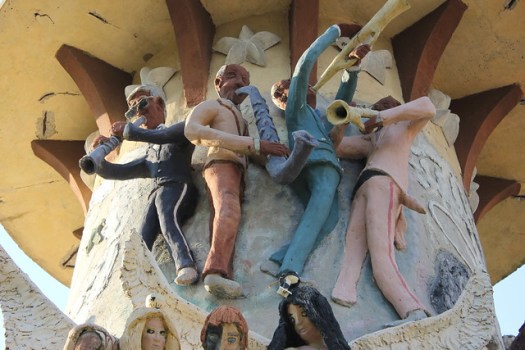
Besides my home, being with my family wherever on earth we may be, my favorite place in the whole wide world is Kenny Hill’s Sculpture Garden in Chauvin, Louisiana. Here are pics from our latest visit:
Rather than list it here again (because I’ve posted our visits here before), Kenny’s story is here at the Nichols State site. My entire set of pics from the sculpture garden is here on Flickr.
Kenny: Kenny, wherever you are living right now, I get it. Thank you.
There are planned communities of today like those we all think of on 30A, and before that the government was putting together huge neighborhoods to support certain efforts, like this one I saw in Sheffield, Alabama with…well…cute red-roofed bungalows.
In 1918, the government built a neighborhood of 85 homes — red tile roofs, white stucco exterior — a school, parks, and barracks for personnel working in Nitrate Plant #1. As this was during WWI, patriotic sentiment was probably particularly high and the neighborhood was laid out in the shape of the Liberty Bell.
It all came about from a 1917 contract between the US and Airnitrates Corporation, a subsidiary of American Cyanamid, to build the largest plant in the world for the manufacture of ammonium nitrate. During construction of the plant, some workers were even housed in family tents and the workers consumed daily ‘7 tons of meat, 6 tons of bread, 9 tons of potatoes, 2000 dozen eggs, 1-1/2 tons of evaporated milk, and several tons of other miscellaneous groceries.’ The plant was completed in eight months and eight days. (Architecture and Building, Vol 51)
In 1922, it was reported to a Congress subcommittee of appropriations that Nitrate Village One consisted of 2600 people, and the representative asked for $2000 to pay for a teacher ($1500) plus an extra $500 for incidentals, explaining that any unspent balance would be returned to the Treasury. (Sundry Civil Appropriation Bill, 1922)
The planning was done by the firm of Mann and MacNeille of NY, who were brothers-in-law. More about them and their other work here.
We took the boys to lunch at Cafe des Amis in Breaux Bridge for lunch one day — I had the crawfish cornbread appetizer for my entree and Av had the pecan crusted catfish, and the boys snacked on some of these plus some other things. It wasn’t as fantastic as I wanted it to be, but it was maybe a little better than Mulate’s, which was originally here in Breaux Bridge but closed last year (their New Orleans location, though, is still going). The best thing of all at Cafe des Amis was Kelly Guidry’s art (above).
Before leaving town, we ran over to Poche’s for some boudin balls and a couple different kinds of boudin, below — pork and crawfish. Nice:
— The aisles at the Tuscaloosa Home Depot don’t have the ordinary numbers, but go by each year (14 of them now) that Alabama has won the National Championship:
In return for the care, the troops get the occasional donated meal or a hug from patients, plus valuable training. Their work is part of a program that sends guard members and reservists into some of America’s poorest communities, where they learn to set up health clinics and other projects and deal with large numbers of people, just as they might do after a natural disaster or in a foreign county.
— I’ve known about Roku for a while, but this week I got to know Roku and it is a fantastic little (really, little) box. All my Netflix Instant + Amazon Prime + Pandora channels + News (like…NPR: listen to Fresh Air whenever) + specific channels not available anywhere else + tons more. The unit is well less than $100 and there are no monthly fees. That’s it. Thank you, Roku. Thank you, early Mother’s Day present.
Last fall, we went in search of William Edmondson works — he was born in the early 1870s to former slaves (‘Edmondson and Compton slaves’ he said) and went on in 1937 to become the first black person to ever have a one-man show at MoMa. He did not attend.
In a press release that year, the Museum stated: Mr. Edmondson, a Negro of Nashville, Tennessee, has had no art training and very little education. He was a hospital orderly for years and a worker at odd jobs. Four or five years ago he became a tombstone cutter and developed an interest in sculpture, which he claims to fashion at G-d’s command.
Mr. Edmondson’s sculpture comes within the category loosely called “modern primitive.” Alfred H. Barr, Jr., Director of The Museum of Modern Art, says of his work: “Recognition of the achievements of naive or self-taught artists is one of the discoveries of contemporary taste. Usually the naive artist works in the easier medium of painting. Edmondson, however, has chosen to work in limestone, which he attacks with extraordinary courage and directness to carve out simple, emphatic forms. The spirit of his work does not betray the inspiration which he believes to be his active guide.”
There has been significant damage to the monuments at Mount Ararat; none of his stones remain here, either being stolen or donated. I think the top of this stone below is related to some of the more plain monuments he made, but the lettering here is not his, as his letters on monuments are broad outlines. I took pictures of a few more interesting ones overall, no matter if they were Edmondson’s works or not. Edmondson himself is buried in this cemetery, in an unmarked grave.
Edmondson has been quoted: This here stone and all those out there in the yard come from G-d. It’s the work in Jesus speaking His mind in my mind. I must be one of His disciples. These here is miracles I can do. Can’t nobody do these but me. I can’t help carving. I just does it. It’s like when you’re leaving here you’re going home. Well, I know I’m going to carve. Jesus has planted the seed of carving in me.
This is what some of Edmondson’s monuments looked like.
Edmondson’s ‘fame’ came quickly as it was only in the early ’30s that he picked up his chisel and by ’37 was showing at MoMA.
Cheekwood Art and Gardens in Nashville currently has the largest collection of Edmondson pieces, but when we were there in October, we were told they were out on loan to another institution.
— This work of Edmondson’s is on auction now; estimate $20-$30k. The catalog lists it as ‘critter’ but I think it’s one of his rabbits, showing a fair amount of environmental wear.




You must be logged in to post a comment.