Rosh Hashanah Crafts

It’s almost Rosh Hashanah, so I’m decorating again…

Sculpey apple thumbtacks and magnets I’ve made:
Sculpey Apple Craft I Made

This is from three years ago, when it was 5769 (I’ve gotten the numbers from Michael’s, and spraypainted them silver, every year), and also this shows the Shana Tova banner I made:
Shana Tova Paper Banner I Made

…and caramel apples for a sweet New Year too!  Just piped the year on this one with chocolate:

Caramel Apples

These made everyone happy.

Caramel Apples

I need to take some pics of this year’s things!  Soon…

Hallelujah Biscuits

These are the best biscuits I’ve ever made, everrrr.  And I’ve made them so many times with both buttermilk and the boys’ 1% milk that the recipe is so good it turns out great either way.

No rolling pin, no cutting them out.  The secret to great biscuits, which everyone knows already, is to use a cast iron skillet and to preheat the pan the entire time in a 500* oven.

Ingredients:
2 cups all-purpose flour
3 tsp baking powder
1/4 tsp baking soda
2 tsp salt
1/3 cup cold butter, diced in smallish pieces — plus more for prepping skillet
3/4 cup buttermilk or regular sweet milk, or more to get a nice consistency

Directions:
Preheat the oven to 500* with the empty cast iron skillet inside.
Combine the flour, baking powder, baking soda, and salt, then add in the butter pieces.  Add the liquid.
After the oven comes up to 500*, take the skillet out of the oven and put an extra pat of butter inside to melt.  Any extra butter should be poured from the pan back into the mixing bowl (just this little bit of extra butter will not melt the rest of the cold butter in the dough but it will be so nice and brown from being in the 500* oven that it is such a great addition.
Mix the dough again and correct with more buttermilk or milk if necessary.
Spoon the dough into the super-hot skillet.
Biscuits

Start checking on the biscuits at 12 minutes, they will likely be done right around 15 or 16.  Ooooh they are so good!  Tall and big and fluffy, and buttery-crusty on the bottom.  Could not be better.
Biscuits


The best biscuits I ever had were at a festival in the mid/late 80s when I was growing up, at Horse Pens 40, and they were called ‘Baptist Biscuits’ — so good I am still remembering them!  I just did a search, and those Baptist Biscuits have even been mentioned a couple of times in newspapers, that they originated with Aunt Plummer Hyatt in 1961 who cooked them there in a wood-burning oven under the sweetgum trees.

In 1973, the Tuscaloosa News reported on a festival there with bluegrass and Sacred Harp music, and quoted on person as saying:
“After that, you’ll have your lungs full of mountain air and your belly full of Baptist biscuits…” 

This Week’s Various

NYT slideshow and more of Rosh Hashanah food.  Jam cake is obvious, but jam-filled mandelbrot?  Must be tried.


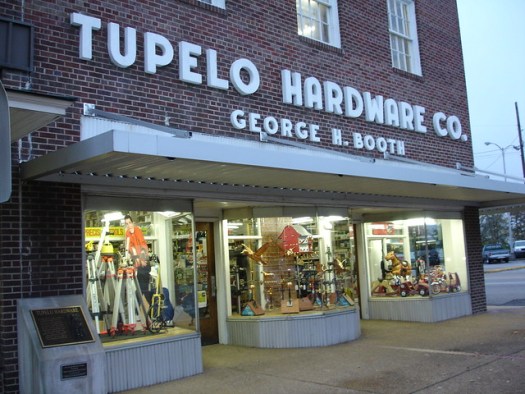
Tupelo Hardware Company, Tupelo MS
September 24 and 25, Guernsey’s Auction House will sell among its other listings Elvis’ first guitar, the one Gladys bought him at Tupelo Hardware.


If you listed to Terry Gross on NPR, Fresh Air, you know she is a great interviewer.  This week’s interview with Maurice Sendak was so raw and so truthful — among the best ever.


The NYT has a piece on food from the War.  Not so much sugar, lots more salt.


A tin tree.


Goodwill Industries of Middle Tennessee posted what’s believed to be a rare photograph of Robert E. Lee on their auction website and it sold for $23k.


Finally on September 19, Roberta Smith did what she needed to do.  The American Folk Art Museum seemed teetering on closing.  As arts critic for the NYT, she began her article with the words, “Please. Someone, everyone, do something to save the American Folk Art Museum from dissolution and dispersal.”  She goes on:

But we should be clear about one thing: There was no failure of curatorial vision. During its 10 years in its new home the museum functioned more or less as the center of folk-outsider art research and development in this country, if not the world. It mounted exhibitions of outsider greats equal to any insiders the 20th century produced, among them Martín Ramírez, Adolf Wölfli and Henry Darger, the Chicago recluse who is represented by a gift of some 5,000 artworks and related materials. Drawing primarily from its collection it has organized inspiring exhibitions of quilts, painted furniture, whitework coverings and sandpaper paintings, and the thick-piled, often pictorial textiles known as bed rugs. It took the survey of Thomas Chambers, one of the great undersung masters of 19th-century American marine and landscape painting, originated by the Philadelphia Museum of Art.

Wednesday night, it was announced that *the museum will stay open*.  Thursday I got an email from the Museum, noting:

In addition to developing a financial plan, the Trustees are also creating a strategy that will increase the visibility of the Museum’s renowned collections and extend the American Folk Art Museum brand. The Museum will seek to establish a revitalized and expanded program of loans to collaborating New York City institutions, as well as packaging traveling exhibitions around the U.S., as ways of sharing folk art with wider audiences. The Brooklyn Museum, the New-York Historical Society, and the Museum of Arts and Design have expressed interest in working with the American Folk Art Museum to identify potential exhibitions where the museums respective collections inform and excite one another. The Metropolitan Museum of Art will display approximately 15 major works of art from the collection in honor of the opening of the American Wing and The Henry R. Luce Center for the Study of American Art.

Well, yay!


Rachel Bobo, I miss you terribly on FB!
Dockery Plantation

The last time we were in the Delta, we stopped at Dockery Plantation just outside Cleveland.  It’s one of the places believed to be the ‘birthplace of the Blues’ as among its residents were Charley Patton, Henry Sloan, Howlin’ Wolf, Willie Brown, Tommy Johnson, and Roebuck ‘Pops’ Staples.  There’s a historical marker about that also.

This restored (but not functioning currently) service station is on the grounds:
Dockery Plantation

Dockery Plantation

Dockery Plantation

…as well as some storage and processing buildings:

Dockery Plantation

Dockery Plantation


Killdeer Eggs
The boys found this nest (or what’s not really a nest) of these Killdeer eggs there outside the Plantation church — Killdeer will lay their eggs right on the ground, like here where they’re so well camouflaged with the gravel.

The High Church of Capodimonte

I have a friend who knows that I’ve never met a museum I didn’t like (just the idea that someone would go to the trouble of opening a museum about any particular genre or thing, I find completely charming), so we were off to the High Church of Capodimonte, the Evelyn Burrow Museum at Wallace State in Hanceville.

Evelyn Burrow Museum, Hanceville AL
There was crystal.  There was Bohemian glass and Carnival glass.  There were bronzes.  But oh, my, was there ever Capodimonte.

Evelyn Burrows talks about her collection on looping video, under her porcelain chandelier:

Evelyn Burrow Museum, Hanceville AL

While Capodimonte does nothing for me really, it was sweet to see what the college did for the collection of one of its patrons.

Evelyn Burrow Museum, Hanceville AL

Lots of drama about the fate of the Folk Art museum in NYC going on right now.  More about that later this week.