Twenty-plus years of documenting the South's vernacular art, visionary environments and traditions….plus modern art exhibits, Faulkner and Eudora, and This Week's Various. Welcome.
Thinking about Valentine’s Day coming up… Once when I was little, I asked my Nanny z”l and PawPaw z”l where they first met, and I remember PawPaw answering while sort-of laughing — so I’m not sure if he was completely serious — but the story goes that he was with some friends at the post office, and my Nanny came in, and he said purposefully loud enough for her to hear, ‘that’s the prettiest girl I’ve ever seen’.
He was right. She was gorgeous.
He was back from the war, and they surely knew each other from before since they were so close in age and lived in the same small town. I think he meant it was the first time he realized they were meant to be together.
Last year on the way to Guntersville, I stopped in the building and found this magnificent interior with *all that marble*, the tile-work, heavy wood doors, and those gorgeous old banks of mailboxes. It makes me like that story even more if that’s possible, to know it was in this setting.
(me and my sweet PawPaw in 1999, at my wedding)
Av and I met through a mutual friend, an older gentleman who I did business with through the company I was with. Our first date was at a restaurant known as being ‘the most romantic restaurant’ in the city, something they advertised. It must’ve worked; coincidentally also having supper there that night (another friend of Av’s) was the girl who would shortly thereafter become my best friend all this time. Sweet.
I had a friend in college whose mother cooked elaborate suppers for the family every night. She was in the kitchen all day, from breakfast to supper, hours and hours making these fabulous meals. It was…who she was — if you asked her what she liked to do, it was cook, and she never tired of it.
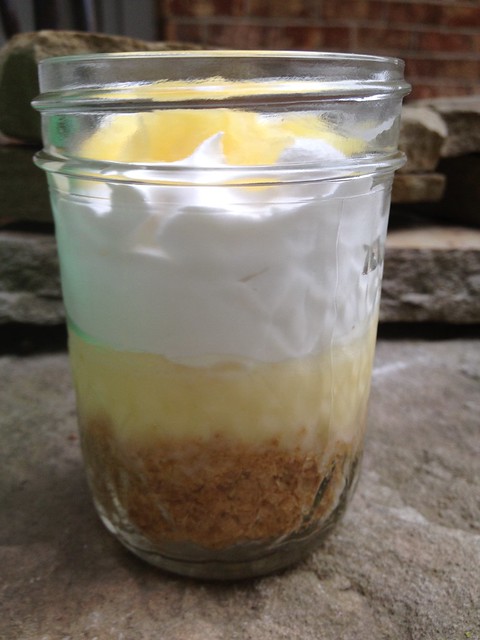
Maybe the easiest thing she ever, ever made was this (probably from the ’50s) dessert she called ‘pineapple delight’ and it was my favorite. I like to make it and put it in pretty jelly jars for individual servings, but you can make it in a big 9×13 pan as she did. Either way, yum.
— If you know me in ‘real life’ then you may have heard last week about the excitement with a house fire in a different neighborhood from where we live — we saw it when driving to Home Depot — and everything that went on. It turned out fine, but a miracle! I was so appreciative of the fire department that came to the rescue. They first checked on those of us who had gone inside, and saved the house secondly. In appreciation, I made this dessert and brought it to them at their station. Now they are enjoying the retro yum too.
Ingredients: 2-1/2 cups graham cracker crumbs 3/4 cup melted butter
1 1/2 cup confectioner’s sugar 1 large or extra large egg 1/2 cup melted, cooled butter 1 teaspoon vanilla
1/2 pint whipping cream 1 regular-size can crushed pineapple (I think that’s something like 10 or 12 oz)
Directions: Mix together the graham cracker crumbs with the melted butter, and spread into an even layer of the pan or jars — I think this makes about 12 jars’ worth — whichever you’re using.
Beat together the confectioner’s sugar, the melted and cooled butter, egg, and vanilla. Pour that on top of the crumbs.
Note: think about saving just a little bit of the pineapple to dot the top of the dessert with, and if you like that idea, then hold back some (as in the pic above).
Top the yellow layer of the sugar/egg/butter/vanilla with the mixture of whipping cream plus the crushed pineapple that has been drained.
“New Orleans is a sugar town, always has been,” said Dwight Henry, the owner of the Buttermilk Drop Bakery and Cafe in the Seventh Ward, who has been baking here for more than 30 years. The region has been coated in the stuff since the 18th century, when spectacular fortunes were amassed on French- and British-owned sugar plantations worked by African slaves all along the River Road between New Orleans and Baton Rouge. Women called pralinières stood streetside in Jackson Square selling pralines, creamy rounds of brown sugar studded with local pecans. When slavery ended, thousands of immigrants from Sicily took jobs in the cane fields, bringing gelato and granita and marzipan to the region.
Today, the remnants of the Louisiana sugar trade are preserved here on menus, in home kitchens and in the memories of citizens whose loyalties to certain bakeries remain part of their local identity. “Whether you get your king cake at Haydel’s or Gambino’s is determined at birth,” said Amanda Hebert, a New Orleans transplant who lives in Los Angeles, referring to two longstanding rival bakeries. So many magazines are published where I live (Time: Southern Living/Cooking Light/Coastal Living/Health/etc to Mental Floss to Flower to the Hoffman titles (Paula Deen/Southern Lady/Victoria etc)), and…between knowing people in that field and seeing what everybody else in America sees, there is a *lot* of styling on steroids. Some of the food styling for one of the city magazines in particular is crazy over-the-top: it would make Caravaggio and even his modern-day admirers blush. But! The vast majority of the images that Pableaux Johnson does in this king cake feature for the NYT are perrrrrfect. Take a look.
—
Image used courtesy jbcurio,Creative Commons Attribution 2.0 Generic. Thank you!
“When I was a boy and I would see scary things in the news, my mother would say to me, ‘Look for the helpers. You will always find people who are helping.’ To this day, especially in times of ‘disaster,’ I remember my mother’s words, and I am always comforted by realizing that there are still so many helpers – so many caring people in this world.” — Mister Rogers One of my friends had posted this quote on FB last year, and I taught this lesson to my boys. Whenever they see an ambulance or fire truck rushing by, they say a little prayer. They are looking for the helpers.
—
Butch Anthony brings Intertwangalism to the UK. Short article at HuffPoUK.
— The Decatur Daily reports that “Alabama lawmakers will discuss the proposed “Scottsboro Boys Act” on Monday in Montgomery.
Last month, State Sen. Arthur Orr, R-Decatur, said he would sponsor a bill allowing Gov. Robert Bentley the authority to pardon eight of the nine Scottsboro Boys defendants”
Which brings us to the the horrible Rubicon that still separates so-called “outsider,” “self-taught,” and “visionary” art from institutionally sanctioned official art. Now that even immigration reform can happen, it’s time for MoMA — and all museums — to integrate “outsider art” into their permanent collections and erase that distinction for good. They need to allow these artists to take their rightful places in the canon. In addition to the artists mentioned above, visionaries like Hilma af Klint, Emma Kunz, Bill Traylor, Adolf Wolfli, Martin Rameirez, Minnie Evans, John Kane, Clementine Hunter, Hector Hyppolite, and others must be integrated into the canon. At the Fair, there’s a 1939–1942 town scene by one of the greatest “outsiders” of them all, Bill Traylor, that would easily compare with any Picasso from the same period. Or, indeed, any artist. With this outmoded discrimination still in place, the story of art is woefully misrepresentative — a lie, even. Millions of viewers and thousands of nascent artists are being denied the chance to see some of the best work made in the last 100 years simply because it was once decided that to be an artist meant having had preapproved training… Similarly, MoMA and other museums once drew strict lines between insider and outsider because they were beset by accusations that modern art could be made by disturbed people and untrained artists. Thus “outsider art” had to be left out in the cold, out of fear. Those embattled borders are long gone; the wars were all won. Museums: I say it’s time for you to set aside these old chauvinisms. There are no more excuses. You’re on the wrong side of history. Your definitions of art are reductive and insular where they need to be inclusive and expansive. You’ve hit a wall. Change — or wither with your prejudices and die a slow death. Me: Yes, yes, yes!!
— …and while we’re telling museums and curators how and where to hang their art, Roberta Smith of the NYT writes ‘Curator, Tear Down These Walls’ on the subject of landscapes in particular: A MODEST PROPOSAL for this country’s great repositories of pre-20th-century American art: Why don’t you, as Diana Vreeland might have asked, mix folk art in with the more realistic, academically correct kind that has so dominated museums since the 19th century? Despite rising interest in and scholarship about folk art — and even after the wholesale rethinking of several major American wings on the East Coast — the isolation of folk from academic is still the norm. Given that we live in a time of eroding aesthetic boundaries and categories, when many curators are experimenting with integrative approaches in international biennials and commercial galleries, it seems past time for the folk-academic division to soften…
The quality of folk art has been recognized enough to be heavily collected by most of these four museums, if not heavily shown. In addition to their formal ebullience, so-called naïve efforts convey the raw desire for art that prevailed in the early years of this country, when museums and art academies were virtually nonexistent. They exemplify an insistent sense of American can-do, the instinctive pursuit of art and, in a way, happiness…
Obviously narratives like the Modern’s omit many worthy insider artists, but outsider art might be the shock to the system that would finally break this linear historical account. Think what might be learned from hanging Bess’s small feisty abstractions among the Abstract Expressionists, or Darger’s intrepid Vivian girls, traced from magazine images, with Warhol’s Marilyns, or one of Ramírez’s patchwork collages next to a Rauschenberg.
Americus has a very nice cemetery, Oak Grove, in the middle of town — I even saw one of the Victorian-era metal monuments, like the ones at Pioneer Cemetery in Greenville, AL:




You must be logged in to post a comment.