Twenty-plus years of documenting the South's vernacular art, visionary environments and traditions….plus modern art exhibits, Faulkner and Eudora, and This Week's Various. Welcome.
In Nashville, there’s a yellow-painted shoebox of a building with this on the front, facing the street: Well, how can you *not* stop for some of *that*??
They had me at the universal symbol for fried pie, up there not once, twice, but three times.
And then you get to wondering what does sweet Mahalia Jackon have to do with fried pies and chicken? Well, in the ’60s a whole chain of restaurants opened up selling Mahalia Jackson’s Glori-Fried Chicken (‘It’s Gloree-Fried, and that’s the Gospel Truth’). They put her image on the packaging, the way the Colonel and Minnie Pearl (whose chicken was, according to the package… ‘How-dee-licious‘) were for their respective franchises.
Most things are cooked here, right out front…
When the first two Mahalia Jackson Fried Chicken restaurants opened in Memphis, in 1968, the paper mentioned that ‘several Southern Christian Leadership Conference officials took time out of their annual meeting to congratulate Miss Jackson and participate in the festivities’ — Ralph Abernathy and Rev Fred Shuttlesworth among them.
They were out of fried pies (!!) and I don’t remember if we were going to have to wait too long on the chicken or what was going on but we got a whiting sandwich…very good:
Joe York did a little film on Mayo and his fried pies:
— Blue Bell Creameries has Mardi Gras Ice Cream! King Cake flavored!
But if you’re looking for it and wonder where it’s stocked, Blue Bell doesn’t respond to their customers on their FB page. They don’t have an active Twitter account. And they ask customers to contact them via a PO Box only. Hmmm.
— There will be a public memorial service for the late artist Sylvia Hyman at The Temple in Nashville on January 27 at 2p.
—
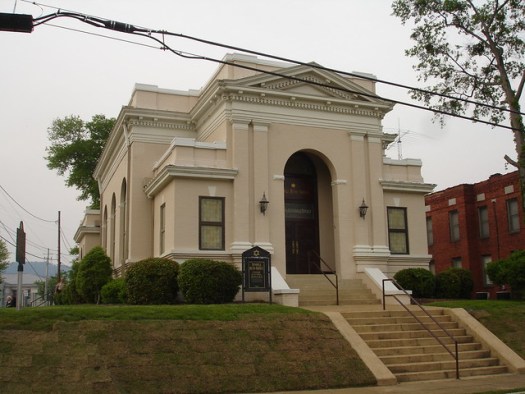
(Selma has something you almost never see in synagogues — an image of a person, like in this stained glass window above, because we go to great lengths to avoid any appearance of idolatry (see Ten Commandments)).
Selma has released the places on their 2013 Spring Pilgrimage, March 15-16 — it includes one of my favorite synagogues anywhere (and where I’ve been to a handful of services), Mishkan Israel…that’s one of its windows above.
— Yes! SoFAB, the Southern Food and Beverage Museum has launched an online international culinary dictionary called NittyGrits.
— So nice — the art of Levi Fisher Ames at the Kohler Arts Center. From ArtInfo:
During his lifetime he refused to sell any of the pieces, believing they were inextricably linked to the stories and needed to remain together to be appreciated. Yet after he died, the art was all sold to a pawn shop for $133 and almost separated and lost until his family reclaimed them. His grandson would go on to facilitate the donation of the Ames Museum of Art to Kohler Foundation, Inc. in 2001, where the herd of wooden animals is now part of the permanent collection which focuses on self-taught and folk artists.
— February 2013 Travel and Leisure on the Mississippi Delta: Bigger cities in the South—Memphis, Austin, New Orleans—have laid claims to musical greatness, but block for block, tiny Clarksdale beats them hands down. From the Depression on, this Mississippi Delta town has been the heartbeat of the blues. The crossroads of Highways 61 and 49 is where bluesman Robert Johnson supposedly sold his soul to Satan. Bessie Smith breathed her last at what is now the Riverside Hotel. Ike Turner was a native son. Nearby Parchman Farm, an infamous state penitentiary, deserves dishonorable mention for its chain-gang work chant and field-holler traditions. (Elvis Presley’s father served time there.) And Red’s Lounge, on Sunflower Avenue, remains one of the last true juke joints, where old-school acoustic musicians like Robert Belfour play almost every night as owner Red Paden turns rib tips on his pit smoker outside the front door. — The lawsuit from the Faulkner estate on the Northrop Grumman newspaper ad using one of his quotes has been settled.
— James Hood, one of the people who integrated the University of Alabama, has passed away. Hood attended the university for a few months before moving to Michigan and going to school there. He returned in 1997 to earn his doctorate in education, according to the university. In 2010, the university honored his pioneering efforts by naming the site of the infamous confrontation the Malone-Hood Plaza. Hood met with Wallace in 1996, and the former governor apologized for his actions. When Wallace died in 1998, Hood attended the funeral, calling the former segregationist a changed man.
I was contacted a couple of weeks ago to help a certain Travel Channel host/show, to give advice for locations to shoot during their visit to Birmingham. They’re in town now, but where they’re going is embargoed (I can’t say) so there aren’t big crowds. Anyway, I can’t *wait* to tell you about it when I can!!
Continuing with this week’s theme, this is the historic Bethel Baptist Church in the Collegeville neighborhood of Birmingham. SCLC co-founder Rev Fred Shuttlesworth led this congregation from 1953 to 1961. As the church’s website states, ‘It All Began Here’. The church was bombed three times from 1956-1962.
This image shows the outline of Shuttlesworth’s home next to the church. It was heavily damaged after the bombing (16 sticks of dynamite) of Christmas evening 1956: The historic marker reads: Rev. Fred Shuttleworth’s tenure as pastor of Bethel Baptist Church (1953-1961) was marked by demonstrations, bombings and passionate sermons critical of segregation laws. His activism earned him a house bombing, frequent beatings, arrests, and threats to his family. Dr. Martin Luther King Jr. called Shuttleworth “one of the nation’s most courageous freedom fighters.” Shuttleworth organized lunch counter sit-ins and encouraged Blacks to apply for civil service jobs. The church was built in 1926 was bombed three times: Dec. 25,1956: June 29, 1958: and Dec.14, 1962. When a dynamite blast blew the roof off his parsonage, he emerged and told a policeman. “Tell your Klan brothers that if God could save me through this, they’ll have to come up with something better, so the fight’s on.” Although he left Birmingham in 1961 to pastor a church in Cincinnati he returned often to help organize civil rights demonstration, most notably in 1963.
Verso: In May of 1963, Shuttlesworth invited King and others to lead adults and children on nonviolent marches from Kelly Ingram Park to city hall. They wanted city leaders to integrate water fountains and restrooms. The force of high-pressure fire hoses pointed at marchers under orders of Police Commander Eugene (Bull) Conner injured Shuttlesworth and others. King was arrested and wrote his famous “Letter from the Birmingham Jail” essay. National media coverage and the bombing deaths of four Sunday School girls in September at Sixteenth Street Baptist Church horrified the nation. Congress passed the Civil Rights Act of 1964 the following year. The Church, parsonage and guardhouse across the street were jointly granted National Historic Landmark status in 2005. The Bethel congregation completed a new sanctuary a block away in 2006. The historic complex was nominated as a UNESCO World heritage Site in 2007. Following his retirement from the ministry in 2008, Rev. Shuttlesworth returned to Birmingham. In his honor, the local airport was renamed the Birmingham-Shuttlesworth International Airport. This is the church’s current building. They are in the midst of a fundraiser to repair and renovate the original building.
— Now on to the other Beth-El, Temple Beth-El, which is my home congregation in Birmingham. It’s the city’s Conservative synagogue, and in April 1958, a bomb was discovered in a window well outside the sanctuary (this room) on what would be the left side of this image: The bomb had enough dynamite to level a city block, but the fuse burned out, or got wet, just short of detonation. It was discovered the next morning. No one has ever been prosecuted for the bomb.
BTW, if you’ve ever been curious about what Jewish services are like, I did all the graphic design/layout and photography (all but the historic images) for our services guide, viewable here.
— One synagogue bombing went off in Gadsden, an hour from here, and the city where I was born. It happened in 1960, during the dedication of a new education wing at Beth Israel, and many local ministers were in attendance.
Someone threw a firebomb at one of the stained glass windows. The window coverings prevented much damage, but when two congregants went outside to investigate, they were shot by the bomber. Both of them survived, in fact one of them just passed away last month.
The bomber turned out to be a 17-year-old who had attended a speech by Admiral John Crommelin, who was a WWII war hero. He ran for office several times and was rabidly segregationist and anti-Semitic. The teenager was motivated to act against Jewish people, and did so this way. A few weeks after the bombing, he was killed when his car ran off the road.
One of the State Troopers investigating the bombing was my PawPaw’s cousin and best friend. He told us about working this case and many others back then. By virtue of being a State Trooper during this era, especially the time during segregation and Wallace’s most famous stands (doorway speech at the UA campus, the Edmund Pettus Bridge, and countless other events) I think of him and am amazed at the history he must have seen and no doubt been a part of, sometimes wonderful and sometimes shameful.
Since I posted yesterday about 16th Street Baptist Church, today’s post is about the four girls. If you’ve seen ‘4 Little Girls’ by Spike Lee, you may remember some of this from the NYT review:
”Four Little Girls” is Spike Lee’s immensely dignified and moving reassessment of a terrorist crime. This watershed moment in the history of the civil rights movement, the bombing on Sept. 15, 1963, of the 16th Street Baptist Church in Birmingham, Ala., left four young Sunday school students dead (the oldest were 14) and a nation galvanized by outrage and shame. Thirty-four years later, Mr. Lee and the many witnesses he interviews are able to see both the tragedy and the turning point in this event. ”This was the awakening,” says Walter Cronkite, speaking of how the bombing shocked white America as he is interviewed in Mr. Lee’s first feature-length documentary, a thoughtful, graceful, quietly devastating account. It opens today at the Film Forum in order to qualify for the Academy Award consideration that it well deserves. ”Four Little Girls” will be shown later this year on HBO. As what will surely be the only Spike Lee film ever to begin with a Joan Baez record (”Birmingham Sunday,” Richard Farina’s mournful ballad about the crime), ”Four Little Girls” starts off on an intimate note. Old photos, fond memories, childhood anecdotes are among the personal touches that help summon Carol Denise McNair, 11, and Addie Mae Collins, Cynthia Wesley and Carole Rosamond Robertson, all 14. One mother even displays her daughter’s Girl Scout sash, adorned with merit badges. Nothing in the scouting credo could have helped this young girl prepare for what fate had in store. …….. And Denise McNair’s father, one of the film’s most affecting witnesses by virtue of his brave restraint, remembers the day Denise passed the segregated lunch counter at Kress’s store and announced that the smell of frying onions made her hungry. ”I guess that was the night I made up my mind to tell her that she couldn’t have that sandwich because she was black,” Mr. McNair says simply. Near the airport, Greenwood Cemetery has this historic marker: This cemetery is the final resting place of three of the four young girls killed in the September 1, 1963 church bombing of the 16th Street Baptist Church. Addie Mae Collins, Cynthia Wesley and Carol Robertson are buried here. The fourth victim, Denise McNair, is buried elsewhere. The tragic loss of these lives led to the end of the era of massive resistance to social change in Birmingham and the release of the city from the fear which long paralyzed progress in human relations.
Because I’ve always found cemeteries and monuments so interesting — how people, families choose to represent such a place with material, symbols, quotes, etc — we went to find where the four were: Unfortunately, Greenwood Cemetery in the past has been beset with upkeep and records issues.
Carole Rosamond Robertson: She was originally buried at Shadow Lawn Cemetery (for many years poorly maintained) but in 1974 moved here to Greenwood Cemetery to be closer to family.
The Carole Robertson Center for Learning in Chicago is named in her honor. Jack and Jill of America, which Carole belonged to, has an annual day in her memory. From Jack and Jill: In a 1993 article in Essence magazine, internationally known activist Angela Y. Davis, recalled growing up with Carole. Following are excerpts from that article: “I had known Carole Robertson for almost as long as I could remember. Carole was a few years younger than I; my younger sister Fania’s age. Her sister Dianne was my friend, so Carole was more like a baby sister. I was in France, preparing to study at the Sorbonne, when I learned about the bombing. In tears, I rushed to place a telephone call to my parents, hoping all along that the [news]paper was mistaken. On the day I found out about the bombing, all I could think about were Carole’s bangs and beautiful long braids.” “My mother told me that Carole had just called her a few days earlier to ask for a ride to a meeting of the newly formed organization Friendship and Action. In light of school-desegregation orders, a group of Black and White parents and teachers had established this organization as a way of ‘letting our children get to know each other’ and of developing grass-roots activist challenges to racism in the schools. Carole, my mother said, wanted to get involved and was extremely excited about this meeting.” “What bothers me most is that their names have been virtually erased: They are inevitably referred to as “the four Black girls killed in the Birmingham church bombing.” I would like to remember not only the terror that claimed her life and that of her Sunday-school friends, but also the positive lives they claimed for themselves as teenage girls. Along with our memories of that horrible day and what it symbolized, I would also like us all to consider what Carole Robertson, Cynthia Wesley, Addie Mae Collins and Denise McNair might have become.”
Cynthia Dionne Wesley:
Cynthia was a sweet girl with many friends (one of whom, Dr. Freeman Hrabowski, remembers her in the Spike Lee documentary)
Civil Rights Martyr Addie Mae Collins ‘She Died So Freedom Might Live’: But…Addie Mae’s body is not here. In fact, this isn’t the original monument (which was wooden — this monument replaced the older one in 1990). When her family wanted to move her to Elmwood Cemetery back in the ’90s, there was no casket here, which resulted in a court case. This from the NYT in 2001, regarding Addie Mae’s sister Sarah, whose last name now is Rudolph: Mrs. Rudolph remembers that Sunday morning clearly. She, Addie Mae and three of their siblings had walked the 16 blocks from their house to the church, as was their ritual. The Collins children never felt fully accepted at 16th Street. Their father was a busboy at a Chinese restaurant, and their mother a domestic worker in white people’s houses, while the church was home to Birmingham’s black elite: doctors, lawyers, teachers and the like. ”There were a lot of wealthy kids in that church,” Mrs. Rudolph said, ”and they looked down on us because we were poor.” The Collins children arrived late, well into Sunday school, and Addie Mae and 12-year-old Sarah decided to wait in the basement ladies’ lounge until the service began. Before long, Sunday school classes let out, and they were joined by Carole Robertson, Cynthia Wesley and Denise McNair, all of whom would perish moments later. Denise had asked Addie Mae to tie her dress sash, and they were all laughing and talking. ”She didn’t even finish tying the sash when the bomb went boom,” Mrs. Rudolph said. ”I didn’t know what had happened. I said, ‘Jesus.’ And then I just called out: ‘Addie. Addie. Addie.’ ” There is an Addie Mae Collins Community Service program in East Harlem that provides Head Start and other services to children.
…and Denise McNair, who was originally at Greenwood but is now at Elmwood Cemetery. Carol Denise McNair: ‘She Loved All — But A Mad Bomber Hated Her Kind’: Denise was the youngest among the girls. She and Condoleezza Rice were friends from kindergarten.
Denise belonged to the Brownies and did a yearly fundraiser for MD in her carport in which she and her friends would put on skits.
— The Martin Luther King Jr eulogy for the girls can be found here at the King Center.




You must be logged in to post a comment.