Valentines

I’m going to get busy this weekend making this year’s crop of Valentines for Av, but here are some I’ve made previously.

It’s easy: pick an image that sums up your idea, then import into Photoshop.  Add text to the image, save as another file, then upload to whichever photo lab you like.

Each year, I think “how can I give a card that someone at Hallmark in Kansas City dreamed up, and it express my real feelings?”.  This is why I like this so much.  Av knows these pics because I’ve taken them, and adding my feelings to them makes them into a genuine valentine.  Plus they’re funny.

This is how I really feel:

Valentines I Made
Valentines I Made
Valentines I Made
Valentines I Made
Valentines I Made
Valentines I Made
Valentines I Made
Valentines I Made
Valentines I Made

Forkland’s Tin Man

The first time I ever visited Jim Bird’s fields on Highway 43 in Forkland, I was taken with the hay creatures.  But really, it’s the (32′ tall) tin man I’m in love with.  We were there again in January:

Jim Bird's Tin Man, Forkland AL

bathtub feet:

Jim Bird's Tin Man, Forkland AL

“Jim Loves Lib” on the heart:

Jim Bird's Tin Man, Forkland AL

—
These are pics from previous visits of what he’s done with hay bales:

Ship at Jim Bird's Hay Creations, Forkland AL

He actually didn’t set out to make art, but when his baler started producing oddly-shaped bales…

Spider at Jim Bird's Hay Creations, Forkland AL

—
He’s also done a sculpture in York, Alabama:

Rooster, by Jim Bird (of Forkland, Alabama).  York, Alabama

Wade Wharton’s Newest Art

Yesterday was *wonderful* – spent the day with Wade Wharton in Huntsville and got to see all his new art.  Look at this fantastic croc:
Wade Wharton's Newest Art

And this!

Wade Wharton's Newest Art

His head is an antique iron, forked tongue:

Wade Wharton's Newest Art

Cloven hooves:

Wade Wharton's Newest Art

Serpent, flames below:

Wade Wharton's Newest Art
That’s the first biblical piece I remember seeing.  It’s just for fun.  Here are some pics from previous visits:

Wade Wharton's Endangered Art Environment, Huntsville AL

Wade Wharton's Endangered Art Environment, Huntsville AL

Praying Mantis:

Wade Wharton's Endangered Art Environment, Huntsville AL

Volkswagen Man:

Wade Wharton's Art Environment 080510

Wade Wharton's Art Environment 080510

Chigger bug:

Wade Wharton's Art Environment 080510

There are people that have a way with plants…

Wade Wharton's Art Environment 080510

Mr. Wharton with one of his (probably hundreds of) bonsai:

Wade Wharton's Art Environment 080510

Insulator tree:

Wade Wharton's Art Environment 080510

He wants to have the largest, and the largest forest, of bottle trees anywhere.  Those tin stars hanging from some of the branches are the stars that fell on Alabama:

Wade Wharton's Endangered Art Environment, Huntsville AL

Some other pics of his art environment are here.  In late November, one of the television stations did a feature on him, and he called me today to say that the library had just called asking if he would put on another exhibit for them!

From the television feature:

The 72-year-old former engineer has spent the last 40 years transforming an ordinary home into something you might see in a Dr. Seuss book – colorful, imaginative and just plain different.

Wharton makes his “art” out of junk. He finds most of his material along side the road.

—

Wharton’s creativity did not kick in until 1974 when a stroke made him see the world in a different light.

“I’ve always been right-brained,” Wharton said. “Then I had my stroke on the left side, made me all right side. I was a free thinker, boy.”

Two years ago, the City of Huntsville told Wharton that he was violating the city code with junk in his yard. He was ordered to throw away anything that he did not consider “art”.

Wharton opens his home, off Nassau Drive, for tours.

Mr. Wharton loves visitors.  If you’d like his # or directions to his home, just email me (ginger ***at*** deepfriedkudzu …dot… com).

—
Other things this week:

The NYT has an article about the Watts Towers entitled A Hidden Treasure Struggles in Los Angeles

This is *amazing*!!

…and this is so smart.

Earlier in the week I posted another piece about 20k houses; these are tiny (500 sq ft) but lovely rental homes in Ozark, AL featured in a tiny house blog

In Atlantic City, NJ they have decided on a design for a Holocaust Memorial there at the boardwalk, but I like this one much, much better:

Our proposal attempts to question the form remembrance should take in contemporary urban contexts, suggesting a non-monumental way of making the absent present, and linking commemoration with leisure urban activity.

The rust-like light stalks -“Shibbolim” (“Rye stalks” in Hebrew) refer to the biblical story of Shibboleth (Judges 12, 5-6) which has become a synonym for hatred on an ethnic or cultural base. The stalks rise to various heights, sway gently in the wind, and produce soft flute-like sounds. They serve as eternal lights- commemorating the loss of millions, yet emphasizing the absence of numerous individuals. Their collective presence, motion and sound create the effect of an absent-present crowd which has gathered to testify and tell a tragic story.

Working with a slight rise of the wooden deck, the stalks form an urban garden facing the boardwalk. They also relate to the see grass situated between the boardwalk and the ocean. The contrast between the two somehow blurs the distinction between natural and artificial, life and still-life, present and memory.

A low reflecting-pool at the center of the memorial creates a focal point for gathering, holding ceremonies and laying pebbles as an act of grief. It reflects the visitors during the day, and the stalks during the night.

Rather than facing the ocean, the memorial turns its focus to the city and its people. Situating the seating and gathering areas to face the boardwalk, further accentuates the message that memory and grief are inseparable from life, and that the best way to commemorate loss is binding it with the present.

…and…
Forbidden Gardens in Katy, Texas (outside Houston) is closing and can you believe they were trying to sell those thousands of terra-cotta Chinese warriors on Craigslist?

Beautiful Homes of Greensboro, Alabama

There are worlds of other things to show, but these are some of the gorgeous homes that line the street into Greensboro:

Main Street Homes, Greensboro Alabama

This is the part where I miss not going to architecture school and graduating in business and lib arts instead.  Can’t think of what style this is.  Thank goodness I have architect friends.  I’ll update this when I hear the answer!  2.10.11: this is what my friend Larry calls “freestyle Queen Anne”:

Main Street Homes, Greensboro Alabama

I know this next home looks…not great, but…it’s the home of Israel Pickens who was governor of Alabama from 1821-1825, when the capitol was set in what we now call Old Cahawba.  Besides all that, he was a founder of Masonry in Alabama, he invented a lunar dial which told the time of night by the moon, and he built this mansion in 1821 as part of the plantation three miles outside of town that he called ‘Greenwood’:

Main Street Homes, Greensboro Alabama

It’s described in a book I have this way:

“It was furnished luxuriously with an abundance of silver, linens, laces, and with room after room of elegant mahogany suites of furniture.”

Soon after his passing in Cuba (these were the days that people with ill health went to Cuba to regain their strength, like the Vice President from Selma, William Rufus King) in 1827, the furniture was sold and the mansion was moved to this site on Main Street in Greensboro.  It looks as though there is some work going on in the back of the home right now.  Hope this gets restored.

Yes:

Main Street Homes, Greensboro Alabama

Yeeessss:

Main Street Homes, Greensboro Alabama

Fresh Winter Pear Salad

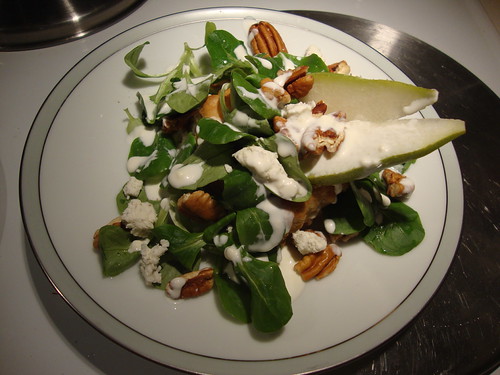
It’s winter, but I’ve been dreaming of summer.  What I really want is a tomato and mozzarella shell, but I don’t buy tomatoes during this time of year.  The other day when Leslie and I went for a trip to go antiquing, we really wanted to find a little tea room for lunch and I was looking forward to having something like this.  Pears are in season between mid-summer and right about now from what I understand so I dreamed this up — and it turned out great.

For the salad (enough for six shells/salads):
One box Pepperidge Farm puff pastry shells – one box has six shells
One package mache rosettes — really you could use any pretty lettuce or spinach but these are fantastic
One pear, maybe two if you’re a real pear lover, seed and cut each into long slices
Six handfuls pecan halves, one per salad
Goat cheese – plain or herbed — amount depends on your liking
salt, pepper

For the dressing:
1/2 c. mayonnaise (Duke’s forever)
1/4 c. buttermilk
juice of one lemon (you could use much less, just add it to your liking)

Winter Pear Salad

To prepare, bake the shells according to directions and remove tops.  Simply put some pear slices, mache, pecans, and crumble goat cheese in each shell.  Next, put more of those same ingredients all around the shells onto the plates so it’s a nice portion:

Winter Pear Salad

Make the dressing by simply stirring the three ingredients together.  Spoon a little of the dressing onto the salad, maybe add a little salt and pepper:

Winter Pear Salad

A perfect lunch.

20K Homes In Greensboro

These are all in the North Ward subdivision in Greensboro.  The loop has not only Rural Studio homes but Habitat houses.  These are the Rural Studio 20K houses:

20K Homes, Greensboro AL

Loft House – view the interior here:

20K Homes, Greensboro AL

Roundwood House:

20K Homes, Greensboro AL

This little yellow house, left-middle looks like a HERO Habitat house with a Rural Studio-ish porch.  Top right is Pattern Book house, under that pic and to the right is Bridge House:

20K Homes, Greensboro AL
One of the best articles I’ve seen written about Rural Studio in the last couple of years was printed in Metropolitan Home (and some of the homes pictured above were in the issue):

If you’ve heard of Hale County, it might be because it’s the catfish capital of Alabama or because James Agee and Walker Evans visited white sharecroppers here during the Depression, when they researched Let Us Now Praise Famous Men. But most likely it’s because of architects Samuel “Sambo” Mockbee and D. K. Ruth, who, in the early 1990s, established Rural Studio as an offshoot of Auburn University. Rural Studio is a hothouse for architecture students who build sophisticated homes for desperately poor, typically black clients — people who are so cut off from the economic mainstream that the subprime mortgage mess couldn’t even find them.

Dorr, who used to do product development for Baby Gap and, before that, designed for Victoria’s Secret, came to Rural Studio in 2003 from San Francisco. She was looking for something more meaningful to do with her life. Like most people, she’d initially been drawn to Hale County by powerful photos of Rural Studio projects. But when she enrolled as an outreach student, she discovered truths the pictures don’t reveal.  

—

Rural Studio outreach students are often not architects. They don’t receive academic credit — unlike the studio’s regular students, they’re not enrolled at Auburn — and some years they don’t even get to build anything. Birmingham architect John Forney, who has taught at the Rural Studio, explains that Mockbee, who died of leukemia in 2001, created the outreach program because he “wanted to have more people stirring more pots in west Alabama.”

—

Eventually Dorr discovered that some of the widows had, in fact, applied to Rural Development, a U.S. Department of Agriculture program, for loans to help them buy a new house. “Their applications were getting approved,” says Dorr. “There was a stack of them in our local office. And they were just sitting there.” The problem, Dorr learned, was that although the women were deemed good credit risks, their incomes were so low — typically, $637 a month from Social Security — that they could afford to repay only a $20,000 loan. And everyone knows that there’s no such thing as a $20,000 house. “Well, there wasn’t at the time,” Dorr says with a laugh.

She began to frequent conferences about affordable housing and to ask the architects she met if they could design a $20,000 house. “And they were like, ‘Uh, no,'” Dorr reports.

Ultimately, Freear was persuaded to adopt Dorr’s 20K house quest, and he handed it off to the outreach students. He established rules: design a house that could be built with $10,000 in materials and $10,000 in labor. Says Freear, “It’s all about the cost of every nail and every stud.” Because these houses are supposed to be replicable prototypes, big architectural flourishes of the sort that might be laboriously fabricated by highly motivated students but not by ordinary contractors were discouraged.

—

But Dorr’s insight — someone who can afford only a $20,000 mortgage should be able to buy a $20,000 house — has changed the culture of Rural Studio. Freear is determined to keep building prototypes until they find one a bank and a regular contractor can embrace. “For me, it’s a fantastic counterpoint to the other things we do out here,” he explains. So maybe Mockbee and Dorr, who never met, are two halves of a single equation. After all, the 20K house — and also the fresh mint — arrived in west Alabama because Mockbee wanted more people stirring more pots. And Dorr, as it turns out, is a world-class pot-stirrer.

—
My friend Jessie studied architecture at Auburn and was a Rural Studio student — I think she worked on Music Man’s home — she now lives on the Gulf Coast doing important work for disadvantaged people.  Her website is here and when she decides to share her artwork with the world, she puts it on Etsy (nothing on right now, but her meat & three paintings are the best!).