Little Nadine Earles’ Dollhouse

In Lanett, Alabama, there’s a dollhouse built over the monument for Little Nadine Earles, who passed away in 1933.

Little Nadine Earles Dollhouse Monument, Lanett Alabama

When she was four years old, she asked her parents for a doll house for Christmas. Her father started on it, but she became sick with diphtheria, and then pneumonia. Her parents gave her a tea set and life-size doll before the holiday, hoping it would help make her feel better, but she just wanted the doll house, and told her daddy, “me want it now.” She passed away December 18th, before he had it completed. After she was gone, her father hired a contractor to build it at the cemetery. Inside are several dolls, a little toy tea set…

Little Nadine Earles Dollhouse Monument, Lanett Alabama

Little Nadine Earles Dollhouse Monument, Lanett Alabama

The stone reads:
‘Our Darling Little Girl
Sweetest In The World
April 3, 1929
December 18, 1933
Little Nadine Earles
In Heaven We Hope To Meet
Me Want It Now’

Little Nadine Earles Dollhouse Monument, Lanett Alabama

Little Nadine Earles Dollhouse Monument, Lanett Alabama

Below is a photograph inside the dollhouse that shows her friends that came by for her next birthday. The pic is inscribed “Little Nadine Earles Birthday Party” and the date. So sad!

Little Nadine Earles Dollhouse Monument, Lanett Alabama

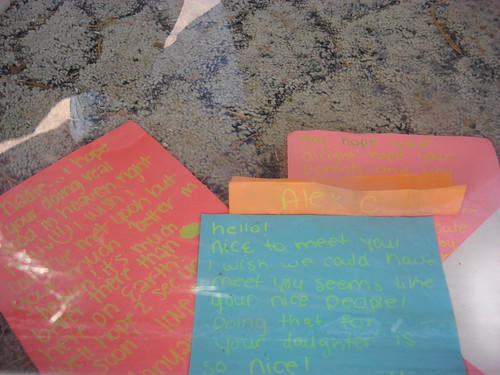
People still leave notes:

Little Nadine Earles Dollhouse Monument, Lanett Alabama

Little Nadine Earles Dollhouse Monument, Lanett Alabama

Her parents are buried outside the dollhouse, and Nadine’s brothers have deeded the area to the city of Lanett.

Little Nadine Earles Dollhouse Monument, Lanett Alabama

Little Nadine Earles Dollhouse Monument, Lanett Alabama

There are four other cemetery dollhouses like this that I’m aware of: one in Tennessee, one in Ohio, and two in Indiana.

Reader Wanda (thank you again!) sent me this clip of a cemetery in Florence, Alabama, where things were left in a protected monument for a little girl:

…and that reminds me of the grave of Florence Irene Ford in Natchez, who died in 1871 at the age of 10.

Monument for Florence Irene Ford, Natchez City Cemetery, Natchez MS

From the city’s site:
Upon her death her mother was so struck with grief that she had Florence’s casket constructed with a glass window at the child’s head. The grave was dug to provide an area, the same depth of the coffin, at the child’s head, but this area had steps that would allow the mother to descend to her daughter’s level so she could comfort Florence during storms. To shelter the mother during storms, hinged metal trap doors were installed over the area the mother would occupy while at her child’s grave.

…you can see the trap doors behind little Florence’s tombstone, which covers the stairway her mother used. They can still be opened today.

Stairwell at Florence Irene Ford's Monument, Natchez City Cemetery, Natchez MS

Museum of the Southern Jewish Experience

The Museum of the Southern Jewish Experience should be…I don’t know…10x the size it is here in New Orleans. I’ve been in love with this museum since it was on the grounds of the Henry S Jacobs Camp in Utica, Mississippi featuring an exhibit Av was in — and funny thing, the exhibit upstairs now, Shalom Y’all, is the same from then — a timeless selection of photos by Bill Aron.

Speaking of Jacobs Camp, we used to stay in Jackson, Mississippi for a week in the summer so these guys could attend as little day campers, then they each did a summer before Shug found his “home” camp in Georgia and Shugie decided he wanted to do a thousand different things over a summer instead of having that experience. That’s okay because this summer I hope to get him busy with the World Games coming to Birmingham, and maybe some flag football at another competition in California.

Shug and Shugie at HSJ


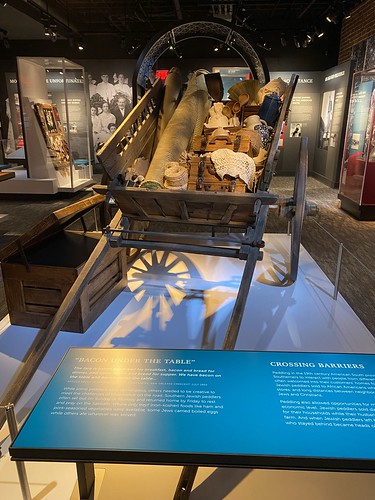
Peddler's Cart, Museum of the Southern Jewish Experience, New Orleans

peddler’s cart

Museum of the Southern Jewish Experience, New Orleans LA

these decorative pieces for the Torah, cover (1960s), crown (1850s), and breastplate (1890s) come from Gemiluth Chessed in Port Gibson, Mississippi (sidenote: it’s no longer serving as a synagogue — but it’s gorgeous)

1885 Victorian crazy quilt made by the Jewish Ladies’ Sewing Circle in Canton, Mississippi

Bertha Hirsch’s 1885 silk wedding dress; the wedding was at the St Charles Hotel, officiated by Temple Sinai’s Rabbi James Koppel Gutheim. The chuppah was “a beautiful umbrella of roses” according to the Times-Pic

Here, a panel on Ruth and her story. She and her sister attend my shul, and I know Ilse a little better (when I volunteered to run the Sisterhood giftshop, Ilse would come in and volunteer too, and I would literally sit at her feet while she told me stories). I’ve made her recipe for chremsel that’s in the Hadassah Jewish Holiday Cookbook, and there’s another recipe of hers that she gave me on a recipe card that I am currently turning my home upside down to find. It’s in the rolltop desk but wherrrrrre in the rolltop desk is something else altogether.

Here, a spunky AZA tee-wearing Av on the trunk of his college Accord with mailsacks of his early publication outside the shul in Jasper, Alabama

Museum of the Southern Jewish Experience, New Orleans LA

Museum of the Southern Jewish Experience, New Orleans LA

Bill Aron’s Shalom Y’all book is available here on Amazon

Have You

Pleasant Valley Missionary Baptist Church: Have You Spoke to G-d

Have You Spoke To G-d
Pleasant Valley Missionary Baptist Church
Pleasant Valley AL, 2021.

Abbey Church & Others’ Thoughts on the New at Notre Dame

The Abbey Church was not open for visitors when we were at St Bernard Abbey in Cullman, Alabama to visit Ave Maria Grotto. It really serves for use by the monks (5 times/day or more) and is not so much a public venue like the other Catholic churches, so they’ve been taking precautions in not opening the chapel to the public. If you’re planning a visit, though, of course call and inquire as to their current policy.

St Bernard Abbey Church, Cullman AL

I’m not Catholic, so for me it’s the architecture and sense of beauty and peace. As a huge aside, one of my best friends (who moved out of town for his career years ago) was very involved in Catholic Charities and one year I got to take part in helping sort donations for Christmas; have maybe never seen a better organized system with so many terrific people in complete joy over what we were all taking part in.

St Bernard Abbey Church, Cullman AL

I’ve mentioned this a bit before, but there’s so much semblance between this and the Holy Name Cathedral in Steubenville, Ohio, pictured in this America Magazine review of the 2018 book, American Catholics and the Church of Tomorrow:  Building Churches for the Future, 1925-1975 (I’m actually reading it now on my Scribd).

St Bernard Abbey Church, Cullman AL

from a visit in 2015:

Abbey Church, St. Bernard, Cullman AL

Abbey Church, St. Bernard, Cullman AL


I’ve been particularly interested in the rebuilding/restoration of Notre Dame, and from the Art Newspaper earlier this month:

Will the fire-ravaged interior of Notre Dame cathedral in Paris be more like Disneyland than France’s most emblematic place of worship when it reopens after a major restoration? So fear the outraged critics of a new interior design for the monument—planned by Catholic church officials—which was presented during a video conference earlier this year.

Although the project has not been formally announced, Father Gilles Drouin provided an overview during an online conference in May for the general secretariat of Catholic education in France, which has been posted on YouTube. Last Friday, the British conservative newspaper The Telegraph denounced the reimagined Notre Dame as a “politically correct Disneyland” and an “experimental showroom”.

At The Spectator, Christian Rousselot, the director general of the Notre Dame Foundation is quoted: “a ‘visitors’ discovery trail’ will ‘provide the keys to half the planet that doesn’t know what a cathedral is.’”:

‘This trail going from north to south from the shadow to the light will depict the major moments of the Bible to explain in the most intelligible way to common mortals, whether Chinese or Swedish, what it all means. Foreign visitors see signs and magnificent paintings but don’t understand a thing. Images and sculptures and paintings count but so do words. So there are plans to project on certain words and expressions in Mandarin, French or Spanish and English.’