
Lucky Losers
Meridian MS, 2019.
Twenty-plus years of documenting the South's vernacular art, visionary environments and traditions….plus modern art exhibits, Faulkner and Eudora, and This Week's Various. Welcome.
Lucky Losers
Meridian MS, 2019.
We got a chance to take the boys back to Avery Island, Louisiana and really enjoyed ourselves; it’s best-known as the home to Tabasco, and there’s a factory tour. It’s thought that the island is atop “solid rock salt thought to be deeper than Mount Everest is high” and we come here for the natural surroundings


*So* much to see here, especially including a bird sanctuary — the number of egrets here is beyond.
This Buddha statue was a gift to E.A. McIlhenny family back in the 1930s. Apparently it was found in a Manhattan warehouse and is 900+ years old


Leaving Avery Island, we were off to another beautiful landscape — Rip Van Winkle Gardens.
Originally hoping this wouldn’t be some sort of kitschy Rip Van Winkle send-up, it wasn’t at all. Named in honor of the character by the actor/owner of the grounds who played RVW 4500+ times (he acted 71 of his 76 years), it’s an amazing 15 acres of semi-tropical gardens. On Jefferson Island, it’s one of the famous “Five Islands” of Louisiana and just like Avery, rock salt. The land was originally owned by Jean Lafitte’s brother-in-law. It’s also famous for a oil drilling accident that caused draining of Lake Peigneur in 1980, and it sounds absolutely horrifying.
The 1870 home there, built by Joseph Jefferson, is “Moorish, Gothic, and French” and on the Register. “The house is a rambling, hospitable structure one and one-half stories high, with a belvedere on the roof and verandas on three sides. A central hall 12 feet wide traverses the house and leads into the dining room at the rear, where there is an immense fireplace capable of accommodating five foot logs. An outstanding feature of the dining room is the beautiful beamed ceiling.”
President Cleveland, a friend of Joseph Jefferson, visited the island a few times. Also, from the Register paperwork: it’s thought that Lafitte sought refuge on the island since his pirate boats could navigate through the shallow waters to access through Bayou Carlin to the lake. “…it is rumored that Lafitte, at various times, buried his booty and treasure here on the Island. Actually, this was partially substantiated in 1923, when a treasure consisting of three pots of Spanish, Mexican, French, and American gold and silver coins was uncovered by an old Voodoo Doctor called Daynite.”
We had lunch at Cafe Jefferson there:


It was just a simple salad-or-sandwich kind of lunch but really terrific for what it was. We’d definitely come back for supper.


Instructional Sink Sign
I-65 Hanceville AL, 2018.
As always, all images unless otherwise noted copyright Deep Fried Kudzu. Like to use one elsewhere? Kindly contact me here.
Affiliate links are sometimes used. That means that if you purchase something via one of the links, it costs you nothing extra, but may generate a commission, offsetting the cost of DFK… e.g. as an Amazon Associate, I earn from qualifying purchases. Also: remember that Bookshop is fab because they’re giving orders to indie booksellers. Grateful for your support. xoxo!

Nashville, 2019.
AN Interior’s Top 50 List this year includes:
BLDGS — Atlanta
Faye + Walker — Austin
Low Design Office — Austin
Max Levy — Dallas
Marlon Blackwell — Fayetteville
Norman Kelley — Chicago & New Orleans
Silo — Cleveland, Charlotte, Fayetteville
Trahan — New Orleans
Also: Nashville’s tallest tower is coming about due to the YMCA’s plan to build a 60-story residential tower on its property on Church Street

Dooky Chase’s, from a 2012 visit.
Produced by Resy and presented by AmEx, the Classics Remix series for New Orleans will do a “Nina Compton x Dooky Chase’s” event the weekend of November 11; dine-in and take-out is $55 and includes Creole gumbo, fried jerk catfish, coconut-braised collard greens, rum & raisin bread pudding with dulce de leche, and a specialty cocktail. Tickets on sale now.

Square Books, 2017.
The delightful Lee Harper will appear on Thacker Mountain Radio, October 28 6p, Live at the Old Armory Pavilion in Oxford
Her Tiny Oxford series began as an homage to Oxford fixture Ron Shapiro’s long-defunct Hoka Theatre, a pre-Starbucks coffee shop fondly remembered by generations of older UM students…led to a string of commissions and explorations of the places that give Oxford its historical local flavor — from architectural gems (both stately and homespun) to the family-run businesses that shaped life for generations.
Her Tiny Oxford, Vol. 1 is available here at Square Books
Flannery O’Connor reads “Some Aspects of the Grotesque in Southern Fiction” and she starts by saying to the class, “any fiction that comes out of the South is going to be called ‘grotesque’ by the Northern reader, unless it is grotesque, in which case it’s going to be called ‘realistic.'”
Seriously, the Flatwoods Monster helped save West Virginia’s Blenko Glass.

Hokus Pokus Liquor, Alexandria LA, 2013.
The Driest State (Arkansas) at Bitter Southerner
— and at Garden & Gun, Dispatches from a Dry County, The daring and danger of living under lingering Prohibition restrictions
…This is a genteel way of saying that, in the largely dry Alabama counties of the Tennessee River valley, the twin crimes of possessing and hauling were made universal. Each drinking-age member of a family—including many scions of staunch dry-law supporters—became what I’ll call a “citizen bootlegger.” Doing the run entered the vocabulary. We all memorized the county roads through the cotton and the various cuts and feints.

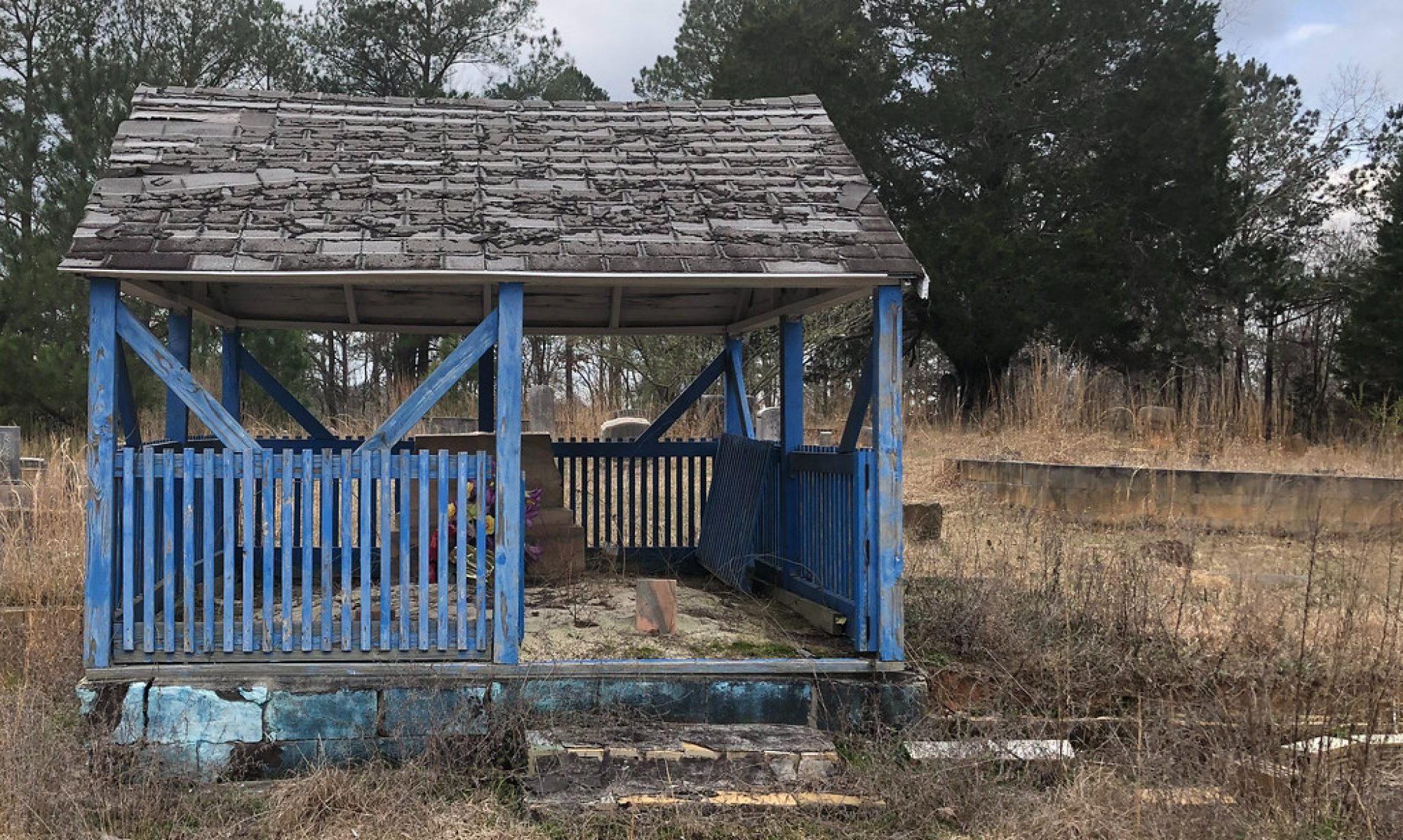
Mount Zion Methodist Church Cemetery, Cullman AL, 2021.
Super random.
At the Clarion-Ledger: Is Tea the South’s next Lucrative Crop? These Family Farms have Mastered the Centuries-Old Art
Wes Anderson designed a train carriage in Britain, and this is beyond
Artist, professor Julie Green passed away earlier this month; she did The Last Supper series of final meal requests
People who go to space seem to have such a clarity about the smallness of things we get caught up in here on earth. Shatner: “I’m so filled with emotion about what just happened. It’s extraordinary, extraordinary. I hope I never recover from this… It’s so much larger than me and life. It hasn’t got anything to do with the little green men and the blue orb. It has to do with the enormity and the quickness and the suddenness of life and death.”
When the Times Book Review Panned the Classics
Susan Spicer’s sweet potato pie recipe, with a praline sauce // Lemon-blueberry griddle cakes from The Blackberry Magazine // whiskey smash
Still completely in love with this house, on the market in York, Alabama

New Orleans, 2017.
Texas Monthly gives this chili history lesson:
The Texanist would further remind you, while we’re momentarily paused here on canned chili, that Wolf Brand has stood the test of time. Before your fellow Corsicanan Lyman T. Davis opened a meat market and began selling his chili under the brand name Lyman’s Famous Home Made Chili in (the Texanist checks his notes) “brick form,” and before he began canning the stuff and rebranded it as Wolf Brand Chili in honor of (the Texanist checks his notes again) a pet wolf who went by the name of Kaiser Bill, he was selling his meaty concoction for a nickel a bowl from the back of a wagon on the streets of your hometown way back in 1895.
Faulkner, with this guide on how to pronounce Yoknapatawpha

Our 2015 Greenberg’s Thanksgiving turkey.
Greenberg’s Turkeys is back after last year’s fire.
Lesley Dill, Wilderness: Light Sizzles Around Me at the Montgomery Museum of Fine Arts, through January 2, 2022. …a new body of work drawing on language, the written word, and the investigation of divinity and devilry during the wilderness of Early America. Her pieces take the forms of long thin figures that wear the strength of the words of the people they represent.

Handley’s Western Wear and Work Boots, Jasper AL
Well, this is… let’s remember this (above) is a 1935 March of Time newsreel about John Lomax and Lead Belly, in maybe the earliest footage there is of him playing. Below, from the Smithsonian:

Seems early for egg nog. Winn-Dixie, Birmingham AL, this week
Gov Guy Hunt Library and Museum in Holly Pond, Alabama


…if you’re thinking: “are those his insoles?” yes, those are his insoles.
And #funfact: for a while when I was in high school, his maid also worked for us — I noticed on the days she worked at our home, the intricately-folded notes to and from my friends weren’t exactly where I would leave them, and they weren’t folded back exactly correctly, either. XD

Pumpkin patch, Cullman County AL

Graceland, from a 2002 visit
Norbert Putnam’s We Had it All, from a 2013 Oxford American:
I felt a certain sadness as I drove home that Friday evening. Usually, I was relieved after a week of grueling Presley dates, but this time had been different. I felt I had been an honored guest at the King’s court, one of only four supporting actors playing along in his simple charade, all for the express joy of his Queen. It was an honor I would never forget. That night I took a silent vow to never tell this story, but many years have passed, and of course, the King has left us.
…on the life and work of Randy Wilson in Hindman, Kentucky:
O How Lovely is the Evening from Alexander Udis on Vimeo.

Zelda.
It’s finally cool outside. For a couple of weeks now, the new (now teenage/young adult) chickens have been living in the big coop with Tallulah and Zelda. Tallulah tells them how things are going to be, but they all get along. They all especially love the little cherry tomatoes that come off the tomato plant that I didn’t even plant this year — it just sprung up on its own outside the run. They eat their regular food along with a ton of herbs we’ve grown plus kitchen vegetable scraps, and the occasional bounty from a bag of carrots put through the Cuisinart for them, and for the worms that we keep downstairs, who also are champion kitchen scrap recyclers. Hope your pets are doing great too, that you’re enjoying the cooler weather, and that your high school football team is also destined for the playoffs. xoxo!
Okay, it’s time. No, wait, I need to start like this: The Ritz-Carlton Lake Oconee (which is actually Greensboro, Georgia) is one of our favorite RCs. And it feels different than the others we’ve been to (Atlanta, Amelia Island, New Orleans, St Louis, and Dallas) because it’s so outdoorsy and not quite so buttoned-up.
I mean, I love the buttoned-up, totally polished too, but this is a sweet departure.

It’s time to figure out holiday plans. Some of the really terrific hotels go to their highest rates and/or they run out of availability. The Ritz Carlton in New Orleans used to be really easy to stay in December over the winter holidays but not right around the bowl games. That’s changed a little, and who knows what that will look like later this year. But the RC Lake Oconee pulls down to a lower rate around the holiday, and it’s also a great time to go.

That’s undoubtedly because one can’t do all the lake activities, etc because it’s cold outside, but the hotel makes up for that with other offerings.

The best way to work around the fluctuations in cost is to book on points when that’s an option, and that’s exactly what we’ve done both times we’ve stayed here. For instance, there are some dates in September that rooms are $1700+. Second week of November, $1900+. There are some $500/600/700 rooms sprinkled around, but you have to get lucky or work around what you want to do with the calendar.

In the summer, we love to go because there are kayaks, canoes, stand-up paddleboard, water bicycle, a great water mat, and more. You can just lounge on the lake beach and get in the water as you please. This is the RC, after all, so there are people everywhere to help with water activities or even just getting your fire pit going in the evening.


This firepit below is used for s’mores every evening.


The pool is a nice size with plenty of loungers, and there’s also a pool for younger guests as well as a hot tub. There’s food/cocktail service at the pool also.

There’s also golf, a spa, an indoor pool, bicycles, access to a sporting grounds, and a little train.

Our first stay was in 2018, when the rooms looked like this, but scroll further down for our stay last December and the new look:


Our latest stay was in December 2020, the last week of the year. The hotel was still beautifully decorated, and this was their gingerbread creation:


Here, the updated room:


Ha, one day we even watched a wedding!


It was cold, so no swimming, and we ate outside at every meal at both open restaurants. The food was not incredible but fine (not going to be too critical as there’s a service shortage and we all need to be especially kind with everything going on).


While the water temperature was too low to get in the water, we still bundled up and sat on the beach, and there was a firepit to keep each group warm


Nightly s’mores was fun, as was the room to explore outside with not too many other guests there.

Another thing to love: so many RCs do a great calendar of events — something going on every single day. For instance, today, there’s “Creepy Candy Crafting” for Halloween, a pumpkin patch, happy haunted hayride, and more. Okay, let’s go. It’s points time. 🙂


Various
Av’s Israel trip, 2018.
You must be logged in to post a comment.