Artsy Asks About ‘Outsider Art’ Privacy

Artsy posted a piece today entitled ‘When Is an Artist’s Mental Health Your Business?‘:

In the case of so-called outsider art, or art made by those distant from the “art world” (often with mental health complications), it’s an even thornier issue. Curators, and those charged with translating and presenting the story of art to a wider public, have difficult choices to make. What details are relevant, rather than just salacious? Where is the dividing line between honest explication and exploitation?

Valérie Rousseau, who works at the American Folk Art Museum in NYC as curator of 20th-century and contemporary art is interviewed, and says:

“We always caricature our fields by saying that we’re all about biographies, and the market builds mythologies around the artist,” she explains, sitting in a gallery full of Gabritschevsky’s fantastical gouache paintings. In the case of these dual exhibitions, Rousseau says, “I didn’t [include] anything specific about their mental illnesses, and everybody is asking me: ‘Oh, by the way, I know it’s not written on the walls—but can you tell me? What exactly was the diagnosis of Gabritschevsky?’ People are savvy and curious about this connection, and they want to know. But I question the validity of giving them the answer.”

…At the same time, she notes, what would providing diagnostic or clinical information really add to that exhibition experience? Audiences, weaned on Hollywood and pop-psychology, might fancy themselves experts—but what comprehension does the casual viewer actually have of bipolar disorder or schizophrenia?

Agreed. There are some instances in which knowing a person’s background means *everything* in giving the art richer meaning and relatedness. I’m thinking here of my very deeply missed friend Wade Wharton, who suffered several strokes in his life. He would tell me over and over about how the strokes literally changed his brain in how he was able to see things, how he was able to interpret things and work them out mentally and with his hands. Because of the strokes, Wade’s walking wasn’t so great (I was always afraid he was going to fall in the yard) and his speech was a little impaired. But knowing about how Wade viewed the strokes as opening his mind to this talent makes seeing it even greater. Wade wanted people to know about the strokes, and there’s no controversy about details like that.

Here, Wade’s “skinny Buddha”

Many other artists I’ve known or studied have been convinced that they’ve been directed by the Almighty to do their work…that they were given a non-verbal sign, or that they were actually spoken to. W.C. Rice believed that he had been healed by G-d in 1960 from an ulcerated stomach, but didn’t start building his Cross Garden in Prattville, Alabama until 1976, the year his mother passed away. Someone had gotten a flower-covered cross at the florist that he was enamored with, then shortly thereafter, the L-rd spoke to him, telling him to put three crosses outside. Then, the L-rd asked him to put crosses in the den of his home. He kept following direction, and in 1980 constructed the ‘Church of G-d, Jesus, and the Holy Ghost Roadside Chapel’. Here, it’s interesting to know the story — especially so since W.C. Rice wasn’t a preacher like Rev Kornegay or Finster who had their own environments — but not absolutely integral in understanding the work.

Turning the page, though, I know of artists who have mental issues going on that should be kept absolutely private. Knowing why someone is obsessed with a certain topic/symbol/word, or the back-story to a work is gratifying in an “I get it now” way, but it’s not an ethically compelling reason to let the world in on what’s going on.

In the Artsy piece, Susanne Zander of Delmes & Zander, whose gallery includes work by the late Louisiana artist Prophet Royal Robertson:

“Essentially, we are not that interested in the mental history of the artist,” she says. “The selection of the artists in our program is based mainly on the quality of their work, irrespective of whether or not it was produced specifically for the art market. It’s important for us that the quality is on a par with established art production, and that the artists are judged not for any of their psychological problems—but rather for the quality, individuality, and autonomy of their artistic work.”

Yes again. Though it seems so interesting that the author here speaks with a gallery which shows the work of the Prophet, because if you didn’t know about his marital problems and his ensuing mental issues/obsessions, you’d wonder why exactly are you hating women? what brings you to that kind of loathing and hostility? and not understand this is part of the deep deep deep dark hole that opened up in his mind with Adell’s leaving.

On the other hand, in her 2011 NYT review of the White Columns gallery show in which he was included, of the Prophet’s personal life, Roberta Smith had exactly this to say:

He believed in space aliens and was fluent in the Bible and furious with his former wife, Adell.  

So there’s that.


BTW, news soon on preservation for Margaret’s Grocery in Vicksburg, where Margaret and the Rev H.D. Dennis loved everybody.

St. Andrew’s

We made another stop at St. Andrew’s Episcopal Church in Prairieville, Alabama — it’s on the National Register and is very simple and striking. Good to see this Upjohn Gothic.

According to its application to the Register, it:

“is a country church believed to be designed by Richard Upjohn” and “was built in 1853 by slaves belonging to members of the church working under the direction of Peter Lee and Joe Glasgow, Master carpenters, who were slaves of Captain Henry A. Tayloe.” Episcopal services were held in Prairieville in 1834 and the church was consecrated in 1858 by the first Episcopal Bishop of Alabama.

It “served the planters of Perry, Hale, and Marengo counties of the Canebrake area and many baptisms of white families and slaves are recorded in the church annuals. After the War Between the States the number of parishioners steadily decreased because of removals, deaths, and a decline in the population of the community.”

“Around about 1950 the bishop of the diocese and suffragan bishop, in alternate years, began holding a service in St. Andrews’s Church on the fifth Sunday of a month late in the summer or early fall. These services are attended by people from far and near and, weather permitting,the congregation usually fills the church to capacity. As many more people, seated outside the building, hear the services through loudspakers. After worship is concluded, a picnic dinner is enjoyed under the shade of the trees in the church yard.”

“A stain brewed from the stems of tobacco plants was applied to the interior wood walls. No change has been made in the tobacco stain finish and it remains in an excellent state of preservation and has a mellowed appearance. The symbols and figures on the altar rail and elsewhere in the chancel were hand carved.”

“The exterior of the church, painted a red-brown color, is made of long wide boards with battened joints fastened vertically to the framework, and buttresses made of thick wooden boards spaced at appropriate intervals; its lancet windows and high pitched roof are features of the Gothic style of architecture.”

“There is some evidence that the present Gothic entrance replaces a high tower which was removed because of damage caused by decay and woodpeckers. With the exception of the removal of the tower and the construction of a chimney on the south side of the nave, the edifice stands exactly as it was when built.”

The cemetery has some interesting monuments, and this spring, a number of crawfish castles

Table tombs

The Historic American Buildings Survey (HABS AL-291) that photographer Alex Bush did on July 31, 1936 (no copyright restrictions on these images from the LOC), shows the interior.

There are still one or two services each year at the church (including a fall Homecoming). Beautiful.

Top Of Atlanta, And The Chocolate Blue Dome

I shall never tire of a revolving restaurant.

We’ve been to the Skylon Tower in Niagara Falls, Ontario, the Chart House at Tower of the Americas in San Antonio, and now both of the ones in Atlanta.

Earlier this year, we planned to celebrate our anniversary by going to the Sun Dial Restaurant for lunch and then later drive to Florence, Alabama for the 360 Grille at the Marriott Shoals (on our way over, after having our reservation for several days via OpenTable, the manager at 360 called a couple of hours before our res to let us know that the mechanism that makes the restaurant revolve hadn’t been working for a few days. I canceled our reservation, but couldn’t he have called earlier than that night so we could have made other plans? It worked out okay because we wound up at Odette which was fab).

The Sun Dial is on the 71st floor of the Westin Peachtree Plaza.

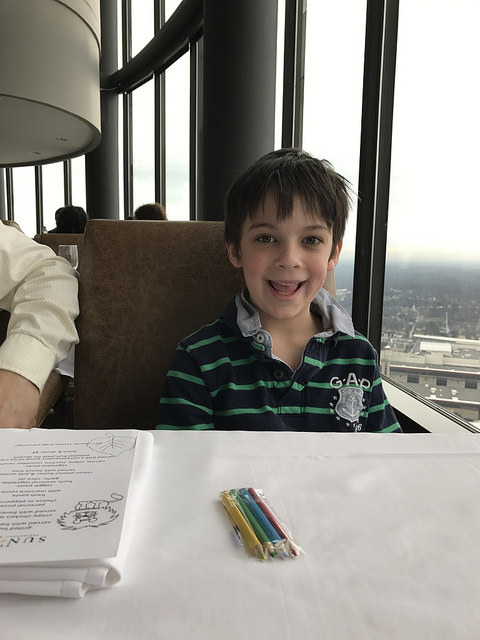
Over the course of…maybe an hour, we got a 360* view of Atlanta, which the boys got a big kick out of


Besides getting to see everything from a window-side table, there’s also an area with an observation binocular

Happy!

Av had blackened Georgia trout over tasso-crawfish grits, which he liked

Shug went with pasta and Shugie had pizza

And I wasn’t so hungry, so I just ordered a Caesar salad which was tiiiiny.


(looking up from the lobby at the Hyatt)

This past weekend, we were in Atlanta again and after supper elsewhere, we walked over to the Hyatt Regency and had dessert at Polaris, which is on the 22nd floor. This time, we had a nighttime view of the city as the restaurant revolved.

We rode right past the open kitchen

We shared the very pretty Polaris Blue Dome: fair trade chocolate mousse, rooftop honey caramel, flourless chocolate cake atop a meringue disc

Delish.

Hotel Finial, Neon, And Pawn Shop Murals

Earlier this year, we went to services in Anniston with plans to go on the next day to Atlanta, so we made reservations to stay at the Hotel Finial. It was recently renovated and had previously been known as The Victoria.

Only suites are inside the main home, and all the other Expedia et al-bookable rooms are in a motel-like arrangement with exterior corridors. That’s what we wound up with.

Parking was in a gated lot. The room was okay — not luxurious (e.g. two pillows on each bed whereas most hotels offer at least three or four) but not uncomfortably minimalist, either. It was fine.

We stayed out until almost bedtime anyway, and when we got up, it was time to walk over to the Victorian home for breakfast, which is included in the cost of a stay. The food was a step up from, say, a Hampton/economy hotel breakfast, and the best part was definitely the setting.

—
That first night, though, for something different, we decided to drive up to Jacksonville, Alabama where a there’s a family pizza place on the square with a fab neon sign — so we figured we’d have supper and walk around…

The boys liked their pizza


We drove back to Anniston for services. The congregation there is so, so kind and they have a great building. The rabbi here drives in from Atlanta and he’s in his mid-80s…he and his wife are just super sweet.


Before we left Anniston, we stopped to take a picture of this great mural at a pawn shop there.