
‘This Week’s Various’ will return on July 5.
Above, the Mississippi River at Natchez

Twenty-plus years of documenting the South's vernacular art, visionary environments and traditions….plus modern art exhibits, Faulkner and Eudora, and This Week's Various. Welcome.
‘This Week’s Various’ will return on July 5.
Above, the Mississippi River at Natchez

Postcard, in the public domain
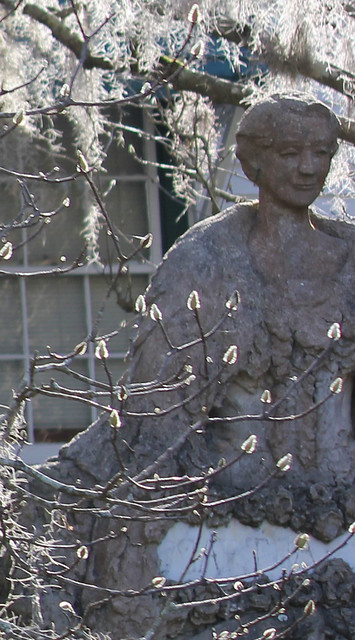
An entry for Laura Pope Forrester (they spell her surname differently, as it most often appears ‘Laura Pope Forester’) appears in the New Georgia Encyclopedia for her work as a self-taught artist in Ochlocknee who “created one of the state’s first outdoor art environments during the 1940s and 1950s. Her concrete figures, depicting such historical and literary personages as Nancy Hart and Scarlett O’Hara, came to be known as “Mrs. Pope’s Museum.””
The AP reported on the site in 1961:
One of the most unique museums in the nation, containing more than 200 statues hand-carved by a Mitchell County woman…
Mrs. Forester’s inventiveness was almost as incredible as her talent. Besides using scrap iron from junkyards, discarded tin cans and other waste material as braces for her statues, she painted the figures with liquids of many flowers and brightly colored berries…
…The sculptress, who created her first statue in 1900, died in 1953, at the Pope mansion in which she was born. The museum is sponsored by a civic club and the Chamber of Commerce.
Two hundred life-size statues…plus she painted, including painting directly on her home. In the early ’80s, the owner of the house reportedly had the statues destroyed in fewer than 48 hours. A witness to what was left later records: “I remember going out behind the house and seeing just piles of faces and hands and such…”
The author of ‘A Palpable Elysium: Portraits of Genius and Solitude‘ includes a quote from the owner who arranged for the destruction as saying, “They had done passed their days of bein’ useful. So we’ve taken down just about all of ’em.”
The author writes:
Based on the evidence that remains, this is one of the worst pieces of unconscious vandalism that one has ever heard of. How could the museums and historical societies and university art departments and collectors of the state of Georgia — or just local citizens with eyes in their heads — have allowed this destruction to take place?
Earlier this year when we were in that part of the state, we drove out to see what was left, as what remains is visible from the street:



Rural Studio = 20 years old.
Wow.
Of all the ways I would re-do college (and my college experience was okay, I have two Bachelor’s degrees from it), there are two main fantasies of doing it differently.
One is going instead to Ole Miss and getting my MA in Southern Studies, then getting a PhD in Art History at UT Austin.
Another is going to Auburn…which as a life-long Alabama fan is…weird, whatever…and getting an architecture degree, and learning from Sambo while he was still with us, at Rural Studio. Then I would run off and design houses for humanity (not faux chateaus or McMansions or starter castles). Real architecture for the people. Learning and doing it in Hale County, Alabama. The part of me that loves thinking about the idea of repairing the world loves this idea.
Well, no matter where any of us went to school or what our course of instruction was, there’s a way to take part in what the Rural Studio has been doing for 20 years now. It’s sponsoring one of the greatest ideas to come from the program, the $20k house, and this is in part how the idea is described at their site:
The $20k House is an ongoing research project at the Rural Studio that seeks to address the pressing need for decent and affordable housing in Hale County, Alabama. Nearly 30% of individuals in Hale County live in poverty. Due to the lack of conventional credit for people with this level of income, and insufficient knowledge about alternative sources of funding, trailers offer the only chance for home ownership. Unlike a house, which is an asset for its owner, trailers deteriorate very quickly and depreciate in value over time. The $20k house project intends to produce a model home that could be reproduced on a large scale, and thereby become a viable alternative to the trailer in this area. The challenge is to build a house for $20,000, ten to twelve thousand of which will go towards materials and the remainder on contracted labor. Once a truly successful model has been designed, the aim is to sell the houses in conjunction with the “502 Direct Loan” provided by the Rural Housing Service.
Rural Studio’s goal for their 20th year is to raise $160k between now and December, enough to build eight $20k houses. Let’s do this.
While enjoying lunch at Parlor Market in Jackson last week, right across the street I saw the new addition to the General Services Administration Building:
…which I free-associated with the glass chapel in Mason’s Bend, Alabama by the Rural Studio, constructed with car windshields:
Last week we were in Jackson and I had the good fortune of being able to see the brand-new exhibit of Jason Bouldin’s portraits of Medgar Evers and Myrlie Evers-Williams in the Icons Gallery at the Mississippi Museum of Art.

Myrlie was the first black woman to graduate from the Law School at Ole Miss, in 1970. She received the Humanitarian Award from Ole Miss earlier this year.
From the Clarion-Ledger:
Bouldin’s voice choked with emotion Monday as he described the tabernacle-style frame of Evers’ portrait; it denotes a dwelling place, housing a cherished image. Listeners grasped each other’s hands as he explained the personal meaning behind the choice. Evers was going home, not going forth, when he was shot. “It is intended to provide a home … for the image,” Bouldin said, hoping it would echo the destination he never reached that night.

Fifty years ago today, Byron de la Beckwith killed Medgar Evers in Mississippi. Ten years later he had a plan to kill the head of the New Orleans office of the Anti-Defamation League (and after being arrested bragged about Evers to a cop named O’Sullivan — oops, this O’Sullivan was Jewish). A few years ago, we found this in a Greenwood, Mississippi bookstore — apparently he distributed many copies of the work “None Dare Call It Conspiracy” with cover letters over the years. An unsettling artifact of regional history.

Jerry Mitchell went on NPR for an interview about Eudora Welty’s story, and called DLB the most racist person he’d ever met.
Delta Drive – the same street that Byron De La Beckwith came in on and left on to kill Medgar Evers – is now named Medgar Evers Boulevard. And so, those kinds of changes have taken place in Mississippi. In a sense, the very thing that Byron De La Beckwith killed a Medgar Evers for, actually in some ways helped to fuel the changes. Those kinds of changes; the street being now named after Medgar Evers, the post office being named after Medgar Evers, the airport now named after Medgar Evers, the building that was built by slaves is now inhabited by an African-American mayor.
So these kinds of things, changes have taken place. At the time that Medgar Evers was killed, very few African-Americans were registered to vote in Mississippi or were able to vote in Mississippi. Today, Mississippi has more black elected officials than any other state. So these are the kind of changes that have come in the wake of Medgar Evers’ assassination.
Here’s the Evers’ home, now a museum — we went by here last week, too. It’s owned by Tougaloo College and available for tours by appointment:
From the Hattiesburg American, at the rededication ceremony a couple of weeks ago:
“When I’m here, I have the spirit of Dad protecting us,” said Reena Evers-Everette, who was 8 years old when her father was gunned down in the carport just after midnight on June 12, 1963.
Evers was the first Mississippi field secretary for the National Association for the Advancement of Colored People, and he had stayed out late on June 11 to attend a community meeting. His wife and their three young children were still awake when he pulled into the driveway.
Evers-Everette said she will never forget seeing her father’s blood as he lay dying.
“He could not get up as many times as my brothers and I said, ‘Daddy, Daddy, get up,'” she recalled.
As always, all images here, unless otherwise noted, copyright Deep Fried Kudzu.

Image used via Creative Commons, courtesy State Library NC. Thank you!
Vollis Simpson was memorialized on Wednesday by state lawmakers in North Carolina, and approved a bill giving the whirligigs he made recognition as North Carolina’s official folk art. Nice!
—
A bit of historical background to the tent meetings article was given this week, in ‘‘Evicting the devil’ nightly at the tent revival in Fairview‘. The 1801 Cane Ridge revival was mentioned. BTW, the Cane Ridge location in Kentucky is called the Cane Ridge Shrine, and is believed to be the largest one-room log structure in the US.
Tent meetings are getting more and more scarce. This is in south Alabama:
Around 7 p.m., the congregation arrives in jeans, flip-flops and T-shirts. Many are young adults. Some bring children.
At one recent service, an offering bucket contains dollar bills, cigarettes, knives, prescription drugs and street drugs. At another, 28 people are baptized in the back of a pickup, lined with a tarp to keep the water in. There’s now a blue plastic pool for that.
“We believe the word of God, the power of God, works best in the worst places — where things are the most unmanageable and most out of control,” said Ramsey, whose past includes meth, rehab and even prison….
…There’s no set order for the nightly service. There’s a keyboardist who sings, but no choir. No bulletin. It’s more “organic” than that, explains Ramsey, also of Heber Springs. He says that what happens at the revival, including how long an evening service lasts, depends on what God puts on their hearts.
…The evangelists brought a trailer with equipment and a motor home, and applied for a permit to hold services on the vacant lot, once a plant nursery.
That was almost a month ago. The evangelists expect to remain until God tells them to leave. “We have no end date,” Ramsey said.
—
“Symbols of Faith, Home and Beyond: The Art of Theora Hamblett” exhibit at the Mississippi Museum of Art ends Sunday. I saw the exhibit at both the Ohr-O’Keefe Museum in Biloxi and at the MMA and *loved* the MMA show and her memory paintings that were included. This is the one to see.
—
When I read that a ‘Kitchen Nightmares’ restaurant had been shuttered for tax evasion, I thought of that strange bakery in Arizona too, but no. Instead, it’s Chappy’s on Church in Nashville, run by the same gentleman that had Chappy’s on the MS gulf coast before K. When the N’ville Business Journal polled whether the appearance on the show helped or hurt the restaurant, 77% responded ‘hurt’. Also, this should be common knowledge by now, but if this show is coming to your restaurant, make sure your walk-in is impeccable with labeled and dated stock, right?
—
The Museum of Alabama at the Dept of Archives and History will open a new, permanent exhibit opening 2014: ‘Alabama Voices‘ “…will tell the story of Alabama from 1700 to the turn of the 21st century through the voices of the people who shaped its history. Taken from diaries, letters, speeches, songs and other sources, these voices will provide context for more than 800 artifacts and hundreds of images that will be included”
—
Do you live in Waffle House America, or IHOP America (love this map)? And yes, there is a Waffle House every 20 feet in Atlanta.
—
—
Randy Owen is irritated about how things are going at the Alabama Music Hall of Fame — or maybe that’s not going, as it’s been closed due to lack of funding (the state just cut funding off for it in 2011). Having it in the Shoals is appropriate if you know all the music that’s been made there, but there’s a big musical tradition that would make it appropriate to sit at the top of Sand Mountain, too. Probably having it move to one of the state’s largest cities would ensure that it gets the foot-traffic it deserves, which equals money. If it could sit as a function of one of our universities, that could be a good fit too, as it would make for a great synergy of resource/interest/documentation/etc.
—
Chastain Park in Atlanta, what has to be one of the best outdoor spaces for a concert ever (having an elegant picnic while listening to live music…mmmmm…), is having a herd of goats keep the kudzu in check this summer.
—
The Washington Post on ‘Our Mockingbird’ and the ghost of George Wallace: Segregation, 50 years on. It’s a documentary by one of my best friends’ sister-in-law, ‘which shows students from all-white Mountain Brook High School and all-black Fairfield High School blown away by the experience of collaborating on a production of “To Kill a Mockingbird”…’
…(the director) observes that there are any number of arguments about why we shouldn’t read “Mockingbird,” any more, “from the n-word to the marginalization of the black characters to Mayella Ewell,” who accuses Robinson after he rejects her.
Yet I hope we never get that correct, and every one of those who was in the play says he or she was profoundly changed by it, and by the collaboration. “I’d been around caucasians here or there,” Stephanie Porterfield, now 24, told me in a phone interview, “but now I can talk to anybody,” and does, in her job as a case manager for older Alabamans….
—
USA Today and others are reporting on a ‘new’ mega-mosquito in Florida, but Floridians say they’ve known about it and it’s just another on the list of giant bugs to deal with.
—

From the A Spoken Dish website:
It’s a simple question: What food tradition in your life reflects time, place, and people, or evokes a specific memory?
In interviews throughout the South, our team of Whole Foods documentarians asked this, and as a result, captured heartfelt stories about the Civil Rights Movement, Hurricane Katrina, the Great Migration, traditional hog killings, magic pickling rocks, southern spaetzle, paw paws, gumbo, and more.
—
June 27th is Helen Keller Day — this article is on Helen Keller’s reaction to the German book burnings of the ’30s:
“History has taught you nothing if you think you can kill ideas,” Keller wrote. “Tyrants have tried to do that often before, and the ideas have risen up in their might and destroyed them. You can burn my books and the books of the best minds in Europe, but the ideas in them have seeped through a million channels, and will continue to quicken other minds…”
—
By next summer, Purity will be distributing their new flavor ice cream “Graham Ole Opry” — an ode to the Opry and Goo Goos. Pizza Hut is going for regional flavors too, in Canada, where they’re now selling ‘Cheesy Beef Poutine‘ pizza.
—

From the AP:
One of New Orleans’ favorite confections is closer to a comeback.
New Orleans’ City Council voted 7-0 Thursday to approve a permit for Hubig’s Pies to establish a bakery in the city’s Marigny neighborhood, in the same general part of the city where a fire last July gutted the bakery that had operated since the early 1920s.
—
The National Trust’s list of ‘America’s 11 Most Endangered Places‘ is out. Included: the James River, and…the Astrodome.
—
The Alabama Historical Commission and the Alabama Trust for Historic Preservation have come out with the 2013 ‘Place in Peril’ list, which includes Painted Bluff in Marshall County (80 drawings at least 600 years old).
Here is the Georgia Trust’s 2013 list. Someone should snap up this $60k 3000sqft antebellum home in Sparta, too. 1912 home for sale in Barnesville with a foot washing tub.
2013 Texas’ Most Endangered Places.
—

Photo, public domain, courtesy LOC Historic American Buildings Survey HABS MISS,1-NATCH,4-1
The owner of Arlington Plantation in Natchez will be in court on July 1 to address violating city ordinance against overgrown property. Above, how Arlington appeared in 1934 — this is how it appears as of 2009; these are pics from the fire and just after.
—
The Sotheby’s auction of several Faulkner lots was mostly unsuccessful. From Oxford’s DMOnline:
According to Agence France Presse, the response to the auction was underwhelming. Several of the most important pieces, including the family letters and a new-found short story, had no buyers. Only 24 of 39 auction lots were sold during the Faulkner auction.
—
Good, good, good stuff:
—
It won’t be finished until fall 2014, but work has started on the 350-mile Mississippi Mounds Trail, “a project to help interpret and preserve the prehistoric earthworks, educate the public about Mississippi’s rich Native American history, and promote heritage tourism. Reaching from Desoto County to Wilkinson County and following the Highway 61 corridor, the trail will highlight thirty or more earthworks built by prehistoric American Indian groups.”
—
Spanish moss does not hurt trees (which we all knew) but the best part of the article in the Tallahassee paper was given by Sam Hand, Jr., Associate Professor and member of the Extension Faculty at Florida A/M University:
“One of the most common questions asked about Spanish moss is “how did it get its name?” No one seems to really know, but of literally dozens of fables, the one I find most appropriate (given its name “Spanish moss”) is that of a mounted Spanish Conquistador, who was pursuing an Indian maiden through a heavily wooded forest, and got his long black beard caught in the branches of an oak tree. The beard was torn off, and over the years it turned gray with age, and ultimately began to be spread by the wind from tree to tree where it began to grow and spread throughout the forest.”
—
Scene at a local cabbage packing shed, 1936. Courtesy: Mississippi Department of Archives and History
Bless those who make their archival photographs available at The Commons on Flickr (‘hidden treasures in the world’s public photography archives, and secondly to show how your input and knowledge can help make these collections even richer’), and that now includes Mississippi Department of Archives and History.
—
The American Folk Art Museum has received a $1.6MM grant from the Henry Luce Foundation which will enable its exhibit, Self-Taught Genius: Treasures from the American Folk Art Museum to travel to five US cities in three years, after it shows at the AFAM next summer.
—
From Mississippi State:
“A pictograph that remained in the dark for almost 6,000 years has come to light with the help of a Mississippi State anthropologist.
Featuring what appears to be a human hunting, the image — certainly the oldest ever discovered in Tennessee and among the oldest yet found in America — is providing new insights into prehistoric life, according to Nicholas Herrmann, MSU associate professor of anthropology and Middle Eastern cultures.”
—
Faulkner is a big reason behind the push to keep natural turf at a field at the University of Toronto and the Toronto city council is deciding on the issue this week.
Toronto city council decides this week if the field should be protected as a “cultural heritage landscape.”
That’s where Faulkner comes in.
In 1918, Billy Falkner from Oxford, Miss., too short to enlist in the U.S., faked a British accent, grew a moustache, added a ‘u’ to his surname and came north to train with the Royal Flying Corps. He was billeted at Wycliffe College. Archival photos show the back campus, where he spent part of his training, a field of tents for new recruits.
Faulkner wrote a fabulous account of Armistice Day, which involved a “crock of bourbon,” and some dubious aeronautical hijinks that caused a limp that endured for years. It’s a story biographer Jay Parini dismissed as an improbable “testosterone-drenched tale.”
—
What Layers in Photoshop are for: photographing lightning bugs in the May-June Audubon Magazine.
—
Everybody needs this in their summer:
http://8tracks.com/mixes/1855965/player_v3_universal
You must be logged in to post a comment.