Fork and Pie Bar, Chattanooga

Looking for something new for lunch in Chattanooga, we decided to give Fork and Pie Bar downtown a chance — and it was pretty good:

Fork & Pie Bar, Chattanooga TN

Fork & Pie Bar, Chattanooga TN

Fork & Pie Bar, Chattanooga TN

Everyone was hungry from being at the Aquarium for so long, so we started with hummus which was a little chunky for our liking so we had to sort through it for the nice smooth part, but the toasted pita with it was great:
Fork & Pie Bar, Chattanooga TN

That day, for savory pies they had: chicken pot pie, bbq (Av got that), veggie pie (that’s what I had), Mexican cantina, shepherd’s pie, spinach orzo, Tuscan chicken, cornbread chili, chili cheese, and Cuban.
Fork & Pie Bar, Chattanooga TN

The sweet pies were: pecan, chocolate, blueberry, and lemon:

Fork & Pie Bar, Chattanooga TN

We got one small lemon, and one small chocolate for everyone to share:
Fork & Pie Bar, Chattanooga TN

Made everyone happy:
Shug and Shugie at Fork & Pie Bar, Chattanooga TN

Alabama Guitar

Av and I had lunch at Rojo in Bham last month, and we met the artist who made this guitar in the shape of Alabama, this gentleman originally from Brewton, named Larry:

Alabama Guitar by Larry, Artist

Alabama Guitar by Larry, Artist
I think he said he made it from black walnut, and gave us a price if we’d like to have him make one for us (super-reasonable, although he said it’s really more for looking at than actually playing). If you’re interested, I have his phone number…contact me and I’ll pass it along. 

Beautiful Boston

Pics from Museum of Fine Arts, Boston

Prayers for the people of the beautiful city of Boston, and us all.

(This is an image I made at the MFA in Boston, when we were there in 2005 for a conference, then vacation. What a gorgeous city.)

National Prisoner Of War Museum

On December 31 when we were still in the Southern part of Georgia, we went through Andersonville without too much planning. Seeing that it was a civil war village, we stopped in the town:
City of Andersonville, Georgia

There was a large (bottom-right image) monument on the main street in honor of Captain Henry Wirz who was commander of Camp Sumter, the military prison for Union soldiers here.  He was one of only two men tried, convicted, and executed for war crimes during the War — and he was hanged in Washington where the Supreme Court building is now; details about testimony against him and his motives, his circumstances (lack of food/medical support from the CSA brought on especially difficult conditions for the soldiers) still abound.  Even so, seeing such a grand monument to someone who oversaw such miserable conditions for people who suffered enormously felt odd.
City of Andersonville, Georgia

Down the road was a National Park Service museum, and generally the NPS museums have made a good impression. That 32000 soldiers were imprisoned here at Camp Sumter makes it appropriate that this be the home of the National POW Museum:
National Prisoner of War Museum, Andersonville GA

National Prisoner of War Museum, Andersonville GA

National Prisoner of War Museum, Andersonville GA

National Prisoner of War Museum, Andersonville GA

A list of rules from Vietnamese captors to POWs:

National Prisoner of War Museum, Andersonville GA

National Prisoner of War Museum, Andersonville GA

These are images of Frances Clolin, who would dress as a man, and take the name Jack Williams, to serve in the Union Army with the Missouri artillery and cavalry.
National Prisoner of War Museum, Andersonville GA

This flag was hand-painted by POW Curtis G. Davis in Camp #10D in Tokyo; against rules, on New Year’s Day 1945, he and his fellow POWs stood attention, saluted, and recited the Pledge of Allegiance. He later said, “I was a very, very proud American Army private that day I can assure you. Some time later the Japanese found the flag, confiscated it and threw it in the office trash. One of the prisoners, emptying the trash, found it and returned it to me.”
National Prisoner of War Museum, Andersonville GA

I went in the museum without Av and the boys as we knew it would be a subject matter they were years from being ready to take in and absorb. They went for a little ride while I toured; I put on a nice face when I got back in the car later, but I was somewhat shaken by all that I had seen. The museum was excellent and presented its subject matter in a way that was very powerful.

Leaving the museum is the National Cemetery — I was told that three funerals were taking place that day.
Andersonville National Cemetery, Site of Stockade, Camp Sumter

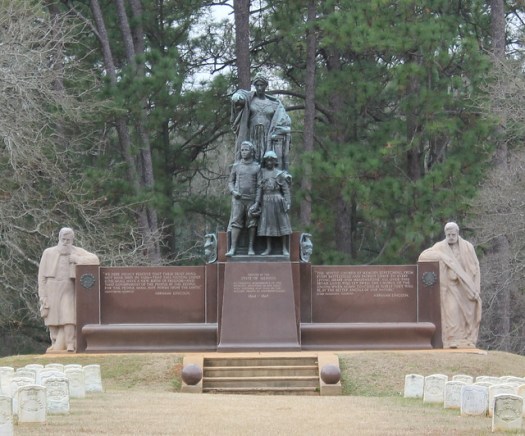
This monument is from the State of Illinois, and it is engraved with excerpts from Lincoln’s inaugural speech and the Gettysburg Address:
Andersonville National Cemetery, Site of Stockade, Camp Sumter

Andersonville National Cemetery, Site of Stockade, Camp Sumter

Andersonville National Cemetery, Site of Stockade, Camp Sumter

Here, an overview of the size of the POW camp:
Andersonville National Cemetery, Site of Stockade, Camp Sumter

A replica of the stockade:
Andersonville National Cemetery, Site of Stockade, Camp Sumter

Campsites inside — the conditions here would surely have been unimaginable:
Andersonville National Cemetery, Site of Stockade, Camp Sumter

One bright spot was that although there was a lack of potable water, this spring that appeared in the summer of 1864 brought much relief to the prisoners, and people would visit it later on Memorial Day:
Andersonville National Cemetery, Site of Stockade, Camp Sumter

Andersonville National Cemetery, Site of Stockade, Camp Sumter

BTW, the man who is credited with killing John Wilkes Booth, Boston Corbett, had been a prisoner at Andersonville.

Quincy, All That For $275K, And Much More For Much Less

Back in December, we drove through Quincy, Florida (a town Bloomberg has written on, for its Coke millionaires):

QUINCY, Fla. — In 1922, tobacco farmers in Quincy, Fla., hauled in a bumper crop and at the urging of local banker Mark Monroe plowed their profits into shares of Coca-Cola Co.

“Coke had just come public and Daddy liked the taste,” recalled Julia Woodward, Monroe’s 80-year-old daughter. “Plus, he figured the stock would be good collateral because folks would always have a nickel to buy a bottle.”

For the progeny of the farmers who heeded the banker and never sold, the payoff has been dazzling. Today, they own 7.5 million shares valued at $375 million. Adjusted for splits, the stock cost them 2 cents a share.

Largess from the town’s 25 Coke millionaires trickles down to the 8,000 residents of Quincy…

…At one time, the town’s residents held two-thirds of all Coke shares outstanding, said Quincy historian Johnny Blitch. As a courtesy to Quincy’s Coke investors, the Atlanta soft-drink company would dispatch a special envoy to town before the annual meeting to collect proxies.

The Coke stock made Quincy one of the wealthiest communities in the country. In fact, before World War II–and before some of the Coke holders left–Quincy was the richest town in America on a per-capita basis.

Accordingly, Quincy has a lovely residential district:

Home In Quincy FL

Home In Quincy FL

Home In Quincy FL
This home above is on the market for $275k (and this (ugh, fuzzy pic I took while driving by) doesn’t even show the lovely little cottage on the grounds).

Twice or three times a year when feeling especially lustful about my dream home, I’ll get look at what ridiculously beautiful, huge homes go for in little towns where the housing market isn’t what it should be (then I dream about aliens beaming that palatial mansion up, then gently back down on our property, of course. this is a dream, after all).

While usually my taste is more Greek Revival, this very moment I’m thinking of *an Upjohn-designed home* on the Register:

(this image in the public domain, from a watercolor done in 1858)

The Richard Upjohn – designed 1860 Kenworthy Hall in Marion, on the market from Bill Mackey:
“…distinguished by its massive brick structure, arched windows, and four story tower. One of the finest antebellum mansions in the South, the estate includes19 acres with original kitchen, carriage house and cistern. Designated as a National Landmark in 2004 and documented in the Historic American Building Survey.” $849,000

Yes, yes.