Twenty-plus years of documenting the South's vernacular art, visionary environments and traditions….plus modern art exhibits, Faulkner and Eudora, and This Week's Various. Welcome.
A couple of months ago, we were in Seale, Alabama:
This is the old Russell County courthouse:
…and the Possum Trot Antiques & Auction house, where if you saw the episode of American Pickers where they visited Butch Anthony (and they tried to make it look like they found his place by accident, ha.), they later tried selling some of their things here:
One of Butch’s signs:
Butch shows yearly at Kentuck; this is his trailer:
In the Riverdale Cemetery in Columbus, Georgia, we found this monument shaped like a carnival tent:
The carnival show train collided with another train that was supposed to have waited for this show train to have passed but did not. Twenty-four people were killed. A newspaper account is here. Sad.
This monument reminded me of this one I had seen on Flickr, at a cemetery in Hugo, Oklahoma which is a town in which circuses wintered. These other monuments are fantastic: here, here, here, here, here, here, here, here, here, and here.
Chris has quite a reputation here for a number of things, but if you ever consider eating at Hot & Hot, know that it is perfectly acceptable to call them first to make certain he will be in the kitchen the night of your reservation (it’s worlds better when he is). Hot and Hot used to be — used to be — my favorite restaurant in town; the first time Av took me there I was enthralled with the actual dishes used to present the food that I went on and on about them…figuring they were custom, only sold to this establishment or to the design trade.
Fortunately for me, I learned that they were made in nearby Leeds by Tena Payne, with a studio open to everyone.
…so today, I have my very own set, which makes me very-very happy. They’re among my favorites, and you’ve probably seen them in may of my food pics here, like this strawberry shortcake:
They are *heavy* though. If you’re doing a supper where there’s a lot of passed food…
The B’ham News reported that for Chris’ appearance on Iron Chef, …At Hastings’ request, Leeds potter Tena Payne — who makes all of the plates, bowls and cups for Hot and Hot Fish Club — created five 15-piece settings especially for the show. “They told us we were the first team ever to bring an entire set of our own hand-designed, handmade plates,” Hastings said. “The plates were a great opportunity for us to show the world visually about who we are, being locally driven.” Payne, under a time crunch to fire and finish the plates, had to drive 16 hours with her assistants Rebecca Sikorski and Bonnie Smith to get them to New York in time for the taping. She also delivered the moonshine that Hastings served as an aperitif, and brought a supply of fresh Alabama vegetables that he needed for some of his dishes. “That might have been a really good thing because you can’t get good tomatoes in New York City,” Payne said. “I mean, come on — it’s not going to happen.”
(Wellll…NYC I’m sure has nice tomatoes but in November, when this was being taped, our Southern garden tomatoes are still going full-steam).
— Smart: Rural Studio is considering a ‘safe room‘ for protection during tornadoes in its 20k homes.
— The Modern Library is reissuing six of Faulkner’s books (Short Stories and Snopes will be released March 13; As I Lay Dying on May 22; Absalom, Absalom and The Sound and the Fury on July 3, and Light in August on Aug. 7.) in commemoration of his 50th yahrzeit in July.
Faulkner wrote about the Derby in 1955, in Sports Illustrated, and his first hockey game in 1954, also for SI: Then it was filled with motion, speed. To the innocent, who had never seen it before, it seemed discorded and inconsequent, bizarre and paradoxical like the frantic darting of the weightless bugs which run on the surface of stagnant pools. Then it would break, coalesce through a kind of kaleidoscopic whirl like a child’s toy, into a pattern, a design almost beautiful, as if an inspired choreographer had drilled a willing and patient and hard-working troupe of dancers—a pattern, design which was trying to tell him something, say something to him urgent and important and true in that second before, already bulging with the motion and the speed, it began to disintegrate and dissolve.
Next month’s George Lindsey Film Festival at UNA in Florence will feature “I’m with Phil” about men named ‘Phil Campbell’ coming from across the country to help the town of Phil Campbell, Alabama after it had extensive damage after the tornado outbreak of April 27 last year.
— The NYT reports that the Brooklyn Museum is putting together 50 items for its “Furnishing Louisiana: 1735-1835” exhibit. “…She is also tracking down furniture with inlaid urns, vines and monograms and butterfly-shaped joints, typical of one unidentified woodworker known as the Butterfly Man. Various potential names have turned up in archives, newspapers and city directories.
“We have these suspects,” including free black émigrés from Haiti named Philippe Auguste and Jean Rousseau, Ms. Gontar said in a recent phone interview. She added, “If I do nothing else in my life, I’m going to find out who that person was.””
— The Smithsonian’s newest museum, the National Museum of African American History and Culture opening in 2015, will have in its collection (among 25k other items) a Spirit of Tuskegee biplane, Emmett Till’s casket, and a dress owned by Rosa Parks. The NYT writes about new civil rights museums and mentions the one to be built in Mississippi as well as the National Center for Civil and Human Rights in Atlanta.
— In the NYT “What You Get For…” feature, they feature a home in Sardis, Alabama with 8000 sq ft for $650k. The listing is here.
I like Temple Heights in Columbus, MS right now — it was built in 1837, has 3650 sq ft, is on the Register, and has a pukah. Pics here.
— The Paris Review writes ‘In Miss Eudora’s Garden‘ Miss Eudora, as native Jacksonites affectionately call her, was a fixture in the capital city of Mississippi from her childhood until her death in 2001. Her presence is still inescapable. Visit the Mayflower Café, off Capitol Street, and you’ll hear about Miss Eudora’s fondness for plate lunches of fried catfish and butter beans. Dig through the waist-high volumes at Choctaw Books and, with luck, you can come across a volume signed in Welty’s bunched and looping hand. Ask an alumnus of Belhaven University about Welty, and they’ll tell you how she used to keep the window of her bedroom open to listen to the music department practice, her head just visible in the top floor window as she sat at her typewriter…
— Robert St. John is back home in Hattiesburg after months in Europe. He writes in a special to the C-L: Every morning for six months overseas, I ate pastries. Most mornings since my return I have eaten pastries baked by a Frenchman. I never once had a croissant in France or Italy better that the ones I eat at Cest la Vie Bakery on Hardy Street.
Steak? Beef is not one of Europe’s strong suits. I never once had a steak in Italy, France or Spain that was better than a chain steak over here.
Pasta? They’ve got us beat. In the Tuscan region it’s all about “local,” freshness and simplicity.
When it comes to seafood, there is no comparison. We live smack dab in the middle of the world’s largest honey hole for fresh seafood. The Gulf of Mexico is tops.
He goes on to mention bread, fruits and vegetables, and about restaurants, he says: We have it made over here. All one needs to do is walk into an independent, locally owned and operated restaurant. My little hometown has an excellent Thai restaurant, several steak joints, an Italian concept, six sushi restaurants, a couple of pretty good independent sandwich shops, an award-winning New Orleans concept, a great bagel shop, and a AAA-rated four-diamond white tablecloth restaurant.
One of my favorite lunches at Bottega (it’s Bottega Cafe at lunch) — nicoise salad — beautiful:
Bottega is owned by Frank Stitt, who is a James Beard 2012 Semifinalist for one of his other restaurants in B’ham, Highlands, as ‘Outstanding Restaurant’. All the semifinalists are listed here at the James Beard site.
Sylacauga, Alabama is an interesting place for cemetery monuments, because sculptors were brought to the area for the large marble industry here. There are two main cemeteries here, one more historic than the other, and they each have nice designs:
This is “Little Samuel,” sculpted by David Herd, who came here from Scotland with his brothers around 1840 or so.
This particular monument was done by Cesare Pillade Falconi, who was born in Italy in 1856 and then moved here in 1910.
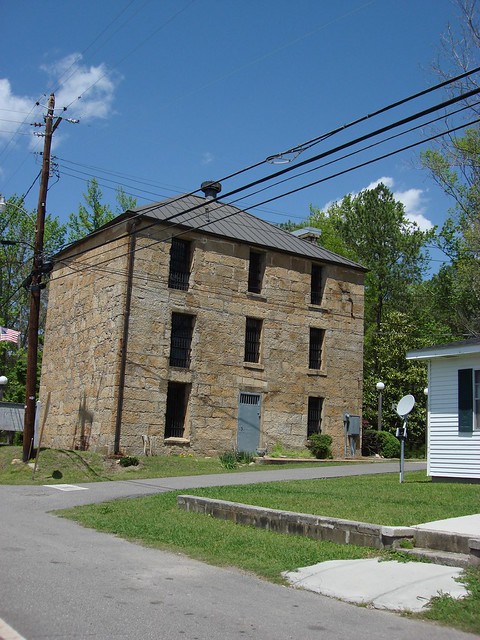
— One of the Herd brothers was also contracted to build this jail of large blocks of native granite in nearby Rockford, which was finished in 1842:


You must be logged in to post a comment.