

…found in downtown Bessemer, Alabama.
Queen City Park

Queen City Park in Tuscaloosa, which has a lot of art deco style — the architect was Don Buel Schuyler — was built, and dedicated in 1943 thanks to the WPA and the Civil Works Administration, with additional funds from the David Warner Foundation. If you’re familiar with Tuscaloosa then the Warner name will likely be very familiar, as that’s the family who, among other things, was the Gulf States Paper Co and gardens on site. In 1960, Jack Warner “commissioned architect Cecil Alexander to model Gulf States Paper’s new corporate headquarters after an eleventh-century palace in Japan, complete with an interior garden inhabited by peacocks and black-necked swans.” More about that later.
This article is about the Queen City Trails.

About the pool, at which this fountain (above) was at the head, it was written almost ten years ago that the “Friends of Queen City Park would like to see it filled to about the two-foot level and turned into a reflecting pool with flower gardens and paths over much of it….A plan commissioned by the city two years ago called for a garden and path over half of the pool and a small therapy pool on the other half.”
This is the bath house designed by Don Buel Schuyler:

It’s slated to become the Mildred Warner Westervelt Transportation Museum — it was written in October that it’s behind schedule to open because “Officials say the setbacks can be attributed mostly to bad luck. Plans to use the original flooring of the former Queen City Bathhouse were scrapped after construction efforts caused too much damage and the floor needed to be replaced. Then, earlier this year, the original contractor on the project went bankrupt, which then caused delays in completing the $1.53 million in renovations and upgrades.”
What’s most interesting in all this is how the Warners have stayed close to this property, and the family’s art collection (which has undergone a great upheaval this year — while many important pieces have left Tuscaloosa, a collection remains as the new Tuscaloosa Museum of Art). And for an idea of what the Warners collect, absolutely see this (paneled walls from an English castle were brought to Jack’s home in Tuscaloosa, for one).
This Week’s Various
Frank Lloyd Wright’s only adobe house, which is fittingly in Santa Fe, is on the market at $4.75MM.
—
James Agee’s article for Fortune Magazine, Cotton Tenants: Three Families, was rejected by the publisher. It ultimately led to Let Us Now Praise Famous Men. Coming in March 2012, the article will be available in The Baffler journal.
—
John Kessler’s review of Southern Art and Bourbon Bar in at the InterContinental in Buckhead appears in the AJC — he calls it a ‘Southern restaurant’ as he puts it, in ‘air quotes looming large’.
The turducken of cheese balls.
—
One of Frank Lloyd Wright’s ‘bootleg’ homes (he designed them ‘on the side’ — in violation of his contract with the firm he was with) is on the market for $1.4MM in La Grange, IL.
—
The only daughter of Joseph Stalin, Svetlana, died last week in Wisconsin. She met her husband, Wes Peters, at FLW’s firm, when she was invited there by FLW’s Russian wife. Her husband was an architect there.
—
For me, the only doughnut is a yeast-based doughnut, but Krispy Kreme has come out with a red velvet cake doughnut. Which gives me pause. Oh — and that red velvet cake ice cream is *sooooo* good! The AP just ran a little piece with a recipe for red velvet cookies.
—
Martha Hawkins, owner of Martha’s Place (and author of Finding Martha’s Place: My Journey through Sin, Salvation, and lots of Soul Food), says she is going to reopen her restaurant in a shopping center on Atlanta Highway. Yay! The Blue Moon Inn cookbook (it was a restaurant in M’ry that closed a long time ago) is also issuing a new edition. Southern Living reprinted their recipe for pimento cheese here.
—
In Australia, the Sydney Morning News readers were asked what their favorite books were. First place: To Kill A Mockingbird. Lots of extras on the upcoming 50th anniversary of the TKAM film on DVD and Blu-Ray.
—
My beautiful, bottle-tree-making friend Stephanie Dwyer is in a commercial for the Chimneyville Crafts Festival this weekend in Jackson. It is always a fantastic show.
Plantation House, School, Wrecking Company, Church, Empty. The Drish Home.

One of my favorite homes in Tuscaloosa is the Drish House at 2300 17th St – it was built in 1837 by Dr. John Drish, and he remodeled it in the 1850s by adding the tower and columns. It was the center home of a several hundred-acre plantation, and it’s believed that the architect was William Nichols.
William Nichols is famous on his own — he was born in England and came to the US in 1800, and became the state architect of North Carolina in 1818. He moved to Alabama in 1827 when he was commissioned to become Alabama’s state architect and thus design the capitol at Tuscaloosa. He also designed buildings to make up the University of Alabama, and every one of them except one were burned to the ground by the Union Army in 1865. His rotunda in the center of campus, pictured below, were among those lost:

(This image is pre-1923, so it is in the public domain.) Nichols went on to Mississippi and designed the old state capitol building and the Lyceum at Ole Miss, besides other projects.
After the turn of the century, the Drish home was turned into a school, then ‘Tuscaloosa Wrecking Company’ which Walker Evans photographed and made famous. Later Southside Baptist bought the home, adding their own building to the side, which has now been demolished. The Drish home alone remains.

Image from LOC, Reproduction Number: LC-USF342-T01-008252-A
It was put on the state’s Places in Peril list about five years ago.

It is said that Dr. Drish had night terrors, and during one episode ran from his bedroom and fell off a banister in the home to his death. His wife grieved terribly. The ghost story is in Kathryn Tucker Windham’s first ‘13 Alabama Ghosts and Jeffrey‘ book. 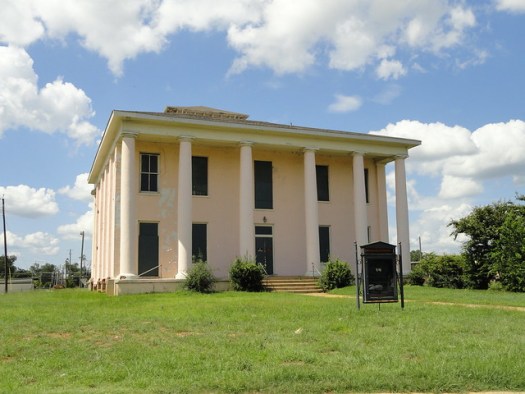

(This image is pre-1923, so it is in the public domain.) This is how the home appeared in 1905.
Hand-Painted In Crawford
In Crawford, Mississippi:

“No Drugs, No Gamblin, No Fighting”
…and at the liquor store on the next block:
Hand-drawn signs for Crown Royal and Gin:
You must be logged in to post a comment.