
Heartbreaking.
Proceed And Be Bold!

Proceed and be Bold! Poster
This print, by York Show Prints in York, AL was hanging in the office at Annie Mae’s Place (Burkville, AL) when we visited this weekend for the annual Okra Festival.
I had heard of York Show Prints before, as they’ve (or maybe more correctly, he’s) been represented at Kentuck Festival of the Arts before. York is run by Amos Paul Kennedy, Jr. and the business doesn’t have a phone…so I’ll have to write him a letter (York Show Print, P.O. Box 154, York, Alabama, 36925) about getting a copy of this “proceed and be bold” print.
((Other really neat show print houses include Nashville’s ultra-famous Hatch Show Print and (I especially like) Yee-Haw Industries of Knoxville.))
“Proceed and Be Bold!” is a catchphrase used by the incredibly talented Samuel “Sambo” Mockbee, cofounder of Auburn’s Rural Studio (and winner in 2000 of a MacArthur ‘genius’ grant, among other awards).
The Rural Studio was developed within the Auburn School of Architecture with intent to get students out of the classroom and in to hands-on work with members of a community that would actually be utilizing their work. In the past, the students’ hands-on experience consisted of them building temporary works…a beam or truss, which would later be torn down. D.K. Ruth, who hired Mockbee at Auburn, discussed with Mockbee that one could take such materials and (rather than a temporary exercise) they could “build something substantial”. It was less pre-conceived notions of what architecture is – be it for glass skyscrapers or McMansions – and more noble architecture of decency for poor people – beautiful whether built with carpet squares, car windshields, or tires. Mockbee died December 30, 2001 but left behind were stunning, noble works for people in one of the poorest areas in the country.
Here are a couple of excerpts from Rural Studio, Samuel Mockbee and an Architecture of Decency:
…”And here we are in the twenty-first century,” Mockbee says, “and we’re still ignoring the problem and southern blacks are still invisible.” He concludes that addressing problems and trying to correct them is “the role an artist or architect should play.”
…”The best way to make real architecture is by letting a building evolve out of the culture and place. These small projects designed by students at the studio remind us what it means to have an American architecture without pretense. They offer us a simple glimpse into what is essential to the future of American architecture, its honesty.”
I have three books about Mockbee and the Rural Studio:
- Rural Studio, Samuel Mockbee and an Architecture of Decency by Andrea Oppenheimer Dean and Timothy Hursley
and
There’s a group on Flickr of Hale County.
Okra Festival, Burkville AL
Av and I went to the Okra Festival this weekend in Burkville (AL).

It was much smaller than the average food-festival, but it was pretty neat. The festival is on the grounds of Annie Mae’s Place, a cottage filled with Annie Mae’s artwork.

Office at Annie Mae’s Place in Burkville, AL, home of Okra Festival

Activist buttons in office at Annie Mae’s Place
Outside, there were vendors selling woodwork, handmade bags, cement creatures, and pickled okra. There were a couple of trucks selling okra and sweet potatoes, and several food vendors with everything from fried okra in cups to sausages, fried catfish, and pig ear sandwiches.

Okra
Av wore his Delta State Fighting Okra shirt and a few people commented on it. One of the blues players even offered Av another t-shirt in trade for his Delta State shirt (Av declined)!

We stayed for a while, and picked up a 2005 festival poster and a t-shirt. The festival posters were done by York Show Print of York, AL…I’ll blog more about them in the next day or two.

Mosquito Mud Pottery, New Smyrna Beach, Florida

Cruet by Mosquito Mud Pottery
Earlier this week I picked up this great cruet by Mosquito Mud Pottery of New Smyrna Beach, Florida. They’ve been open since 1998, and make bakewear, dishes, teapots, and sushi sets. I’ll use this to hold small quantities of olive oil – much prettier than just pouring it out of the plastic bottle.
Pitman Theater, Gadsden AL

The Pitman Theater (629 Broad Street) opened in Gadsden in 1947.
The city of Gadsden received a $165,000 federal grant to restore the theater’s lobby; they’ll have it house a transportation museum and plans are to make the theater itself more of a multi-purpose community center.
Monument to Emma Sansom, Gadsden AL

When I was in first grade at Episcopal Day School in Gadsden, we had a project to learn about any famous person we wanted, and to tell a bit about that person in class. I chose Emma Sansom, because so often we passed the monument to her on Walnut Street and I wanted to learn more about her. I think in first grade the best I could do was that ‘Miss Emma Sansom helped General Forrest cross the creek’!
Can you imagine.
Earlier this week we were in Gadsden and took these pics.
Here’s more about Emma Sansom:
In 1863, Union Colonel Streight dashed across Alabama on his way to Georgia, General Forrest on his heels much of the way. When Forrest came close to Gadsden, he needed a way across the Black Creek as it was up and the bridge was destroyed.
Forrest went to the first house he came to and asked if there was anyone who could show him a way across. No men being home, 16 year-old Emma Sansom spoke up and said that she knew the way and would accompany him if she had a horse.
This report is from The Jacksonville Republican, May 1863:
There being no time for ceremony, Gen. Forrest proposed that she should get up behind him to which, with no maiden coyness, but actuated only by the heroic impulse to serve her country, she at once consented. Her mother, however, overhearing the suggestion, and sensitively alive to her daughter’s safety and honor, interposed the objection. “Sir, my child cannot thus accompany a stranger.” “Madam,” respectfully urged the far-famed chieftain, “my name is Forrest, and I will be responsible for this young lady’s safety.” “Oh,” rejoined the good woman, “if you are Gen. Forrest she can go with you!”
This account is from Bennett H. Young’s, Confederate Wizards of the Saddle:
Without waiting for the assistance of her escort, she unloosed her hold from his waist and sprang to the earth.
The soldier, throwing his bridle rein over a sapling, followed the child, who was now creeping on her hands and knees along the ground over the leaves and through the ticket. The enemy saw the two forms crouching on the soil and began to fire at the moving figures in the bushes. Fearing that she might be struck, the soldier said, “You can be my guide; but you can’t be my breastwork,” and, rising, he placed himself in front of the heroic child, who was fearlessly helping him in his effort to pursue her country’s foes. Standing up in full view of the Federals, she pointed where he must enter and where emerge from the water. Her mission was ended. The secret of the lost ford was revealed. Streight’s doom was sealed. The child had saved Forrest in his savage ride, ten miles and three hours’ time, and now he felt sure that Rome was safe and that Streight and his men would soon be captives in his hands. As they emerged into an open space, the rain of bullets increased; and the girl, not familiar with the sound of shot and shell, stood out in full view and untying her calico sunbonnet, waved it defiantly at the men in blue across the creek. The firing in an instant ceased…
. . . Riding with quickening speed, he galloped back to the house. . . . [He] gave orders to instantly engage the foe. He sent aids to direct the artillery to the newly-found ford, and while they were moving with all haste into position, he drew from his pocket a sheet of unruled paper and wrote on it: Headquarters in Saddle, May 2d, 1863.
My highest regards to Miss Ema Sansom [sic] for her gallant conduct while my forse [sic] was skirmishing with the Federals across “Black Creek” near Gadisden, Allabama [sic].
N.B. Forrest, Brig. Gen. Com’d’g N. Ala.
The following day, Forrest caught up with Streight, and they battled; Forrest demanded Streight to surrender but he refused, demanding to be shown that his men were outnumbered. Although Forrest only had about 400 men and Streight had around 1500, Forrest ordered his men and artillery to move in and out of sight continuously along a ridge, fooling Streight into thinking he was indeed outnumbered. Streight surrendered at noon.
This quote of General Forrest from Edward Longacre’s article in Civil War Times Illustrated (June 1969):
“…When Streight saw they were barely four hundred, he did rear! demanded to have his arms back and that we should fight it out. I just laughed at him and patted him on the shoulder, and said: “ah, Colonel, all is fair in love and war you know.”
In my pic above, you can see that one of Emma Sansom’s fingers is missing; it’s sitting in the mayor’s office (it was returned by a prankster who broke it off!).
There is a marker in honor of Emma Sansom is in Social Circle, Georgia, in thanks to her for helping Forrest capture Streight, who was headed to Rome, GA.
The Alabama State Legislature at one time was discussing the possibility of putting Emma Sansom on the official Great Seal.
Country Captain Chicken
Country Captain Chicken is one of my and Av’s favorite dishes to make at home. I make mine in my Le Creuset tagine but you could use any deep pan with a lid. The recipe below is my variation on it.
Country Captain Chicken may have originated when British colonials brought the recipe here (specifically perhaps to Savannah, GA) from India. John Egerton writes in “Southern Food, At Home, On the Road, In History” that Mrs. W.L. Bullard of Warm Springs, Georgia served the dish to FDR and General Patton, who loved it.
Here’s my recipe for Country Captain Chicken (serves 4):
Ingredients4 boneless, skinless chicken breasts – cut into bite-size pieces
Flour for breading (I always use White Lily)
Salt
Black Pepper
Paprika
Olive oil for frying
One large Vidalia onion, cut into nice-size medium-large pieces
Two green bell peppers, cut into medium-large pieces
Two stalks of celery (optional)
Three cloves garlic
Curry powder
Cumin
Large can stewed tomatoes, with liquid
Small can tomato paste
Two cups white rice, cooked
Give guests option of covering their dish with: peanuts, raisins, or almonds
Directions:
Take cut pieces of chicken and put them in a ziploc bag of flour, salt, and pepper. Shake to coat thoroughly.
Heat olive oil in skillet to medium-high, add breaded chicken.

Cook chicken to a nice color, but don’t overcook – because the chicken will be added back to the pot simmering another twenty or so minutes at the end.
Remove cooked chicken to paper towel-covered plate to rest.

Turn heat down, let oil cool to medium heat. Add onions first – let them cook two-three minutes, then add garlic, bell pepper, and celery (optional) and cook that five or six minutes.

Add tomatoes and tomato paste to the onion/garlic/bell pepper/celery mixture. Cook another ten minutes.

Add chicken back to skillet and spice to your taste….lots of curry, then a little cumin, then some salt, back to the curry, etc. until it’s perfect.

Cover and simmer twenty or so minutes (pot in back is cooking rice, to the left of that is our Red Diamond – soon to be iced – tea brewing).

Serve over cooked rice. Offer guests peanuts, almonds, or raisins to top theirs with. Delicious!
State of Alabama Confederate Memorial Park and Site of Confederate Soldiers’ Home of Alabama, Marbury AL
There are signs to the Confederate Memorial Park in Marbury, AL on I-65 – it’s probably an eight-minute drive or so from the interstate to the park. Unfortunately, the on-site museum was closed, but here are pics from our visit:

State of Alabama Confederate Memorial Park, Marbury, AL

Pictured above is the monument to Jefferson Manly Falkner, who was a Confederate veteran and who donated the land that the park (and Soldiers’ Home site) is on. Many of Alabama’s veterans were in need – financially, physically – that Falkner gave about 80 acres (the park is on 102 acres today) on which was built 22 buildings including a hospital, with 25 beds.
The State of Alabama took over administration of the facilities in 1903, and limited the number of veterans who could live on-site at 100. Between 1914-1918, that number was exceeded, and rules were changed so that wives already living at the facility could remain doing so even after their husbands died. The Home was in operation from 1902-1939.
Veterans’ needs were met – they were supplied not only with a place to live, but with clothes, food, medical care, and a place to be buried (there are two cemeteries, with a total of 313 burials). Between 650-800 veterans were served by the Confederate Soldiers Home.
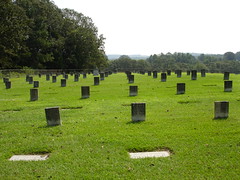
Cemetery Number Two

Tattered Flags
The literature available outside the museum states that the United Daughters of the Confederacy were frequent guests and often brought gifts to the residents. Most important was Confederate Memorial Day in April each year (in Alabama, CMD is always the 4th Monday of April).
Bill Rambo, who is the site director of the park, was in charge of the Confederate reenactors at the funeral service of Mrs. Alberta Martin, the last Confederate widow, who died in 2004.

Old Marbury Methodist Church

Inside Marbury Methodist Church, on grounds of Confederate Memorial Park

Family Bible on Pulpit of Church

View from Pulpit

Simple and beautiful.
Capitol Book & News Company, Montgomery AL
Capitol Books is my favorite book shop in Montgomery (Old Cloverdale neighborhood) – they have a nice selection of everything, but my favorite sections are those of local writers and books about the South…I always leave with something from there!
This is what I just picked up:
Southern Souvenirs, Selected Stories and Essays of Sara Haardt
* Sara Haardt was probably best known as the wife of H.L. Mencken. She was a fabulous writer on her own, writing screenplays, novels, and short stories, although now her work is hardly remembered. She was born and raised in Alabama (at sixteen, she attended the Margaret Booth School in Montgomery – Zelda Sayre (later Fitzgerald) went there too), became active in politics – especially in regards to Alabama ratifying the 19th amendment. She spent much of her adult life in Baltimore…she loved the South, but knew its faults, and really couldn’t bear to live in Alabama again.
Let Us Now Praise Famous Women, A Memoir, by Frank Sikora
* First, I’m not wild about this title; I can’t imagine anyone writing their own account of poverty in Alabama and have the gumption to make the work’s title so similar to the amazing work of James Agee and Walker Evans. This book is about Sikora – an Ohio native – moving to Alabama with his wife, a native Alabamian, and their experiences during 1960’s juxtaposed with the conditions and mores of her economically distressed family.
William Christenberry, The Early Years, 1954-1968, by J. Richard Gruber
* I haven’t even really had a chance to look through this work yet, but it is of course the amazing works of William Christenberry, a native of Tuscaloosa AL (b. 1936) and Bama grad, who was heavily influenced by Agee and Evans’ ‘Let us Now Praise Famous Men’. He’s done a lot of work with his Kodak Brownie (there’s a very nice exhibit of that work at the Montgomery Museum of Fine Arts that I’ve been to) and locations in the South, particularly well known for shots in Hale County, Alabama.
Count Those Buzzards! Stamp Those Grey Mules!, by (and illustrated by) Kathryn Tucker Windham
* Lovely little work of Southern folklore, particularly purposed by children.
Blues Poems, edited by Kevin Young
* Compilation of blues song lyrics and works inspired by the blues.
The Autobiography of A Magdalen by Louise Wooster * Well, Louise Wooster (1842-1913) is best known as “Birmingham’s Madam” and former love of John Wilkes Booth (she couldn’t believe that JWB could do what he did, unless perhaps he was drinking), but wow…..I don’t think anyone after reading her autobiography could possibly have a poor attitude toward her. She was orphaned at ten, instructed to take care of her younger sisters, abandoned by the family that should have taken her (and her family) in, lied to, abused, etc. When she came to Birmingham, there was the terrible cholera scourge which she stayed through and nursed the sick, which endeared her to the community. She didn’t wish the path she had gone on to anyone, but she was nonetheless a truly strong, vibrant woman who, had circumstances been different, would surely have achieved greatness on some other level. I’ll write more about Louise Wooster in an upcoming post.
Hampton Inn, Greenville AL

Our room at the Greenville, AL Hampton Inn
Room: This Hampton Inn in Greenville AL was average Hampton….but we were so happy with it because it was the last room the hotel had this particular night. It was also a ‘smoking’ room, but it really didn’t have any odor.
Lobby: Average Hampton.
Service: Check in/out was fast.
Food: This Hampton is situated close to a Cracker Barrel and some other restaurants (it’s on a service road beside I-65, exit 130). Also on the mile-marker 130 exit is ‘Bates House of Turkey‘, a (turkey) restaurant, which is okay — I wasn’t crazy about their turkey dinner (the turkey itself was fine) — but I wouldn’t hestitate at all to purchase one of their whole turkeys to cook at home: the 10-12lb ones are $46.50.
Extra: This room cost in the mid-$60s with a AAA discount.
Our experience is this: We would stay here again.
You must be logged in to post a comment.